
Why Your Exchange Method Matters More Than Your Timing
Most travelers focus on when to exchange currency - trying to time favorable rate movements. In practice, where you exchange has a far larger impact on what you actually receive. The gap between the interbank rate (the wholesale rate banks use with each other) and the rate offered to retail customers can range from under 1% to more than 10%, depending entirely on the channel you use.
Before comparing options, it helps to understand the key terms involved. Our traveler's glossary of fees and markups covers spread fees, flat service charges, and how markups are calculated - concepts that apply to every method below. And for a deeper look at what moves the numbers on rate boards, see what actually determines the exchange rate you receive.
Option-by-Option Breakdown
Each of the three main exchange channels - airport currency desks, bank branches, and local ATMs - operates on a different cost structure. Here's how they compare across the criteria that matter most to budget travelers.
| Airport Currency Exchange | Bank Branch at Home | Local ATM Abroad | |
|---|---|---|---|
| Typical rate markup above interbank | 8%-15% | 3%-6% | 0.5%-2% |
| Flat service fees | Often included in spread | $5-$15 per order (varies) | $2-$5 per withdrawal |
| Convenience | Immediate, no planning | Requires 3-7 days advance order | Available on arrival in most countries |
| Best for unusual currencies | Rarely stocks rare currencies | Can order most currencies | Availability varies by country |
| Risk of dynamic currency conversion | Low (cash transaction) | None | Moderate - always choose local currency |
| Overall cost for typical trip | Highest | Moderate | Lowest (with right account) |
Airport Currency Exchanges
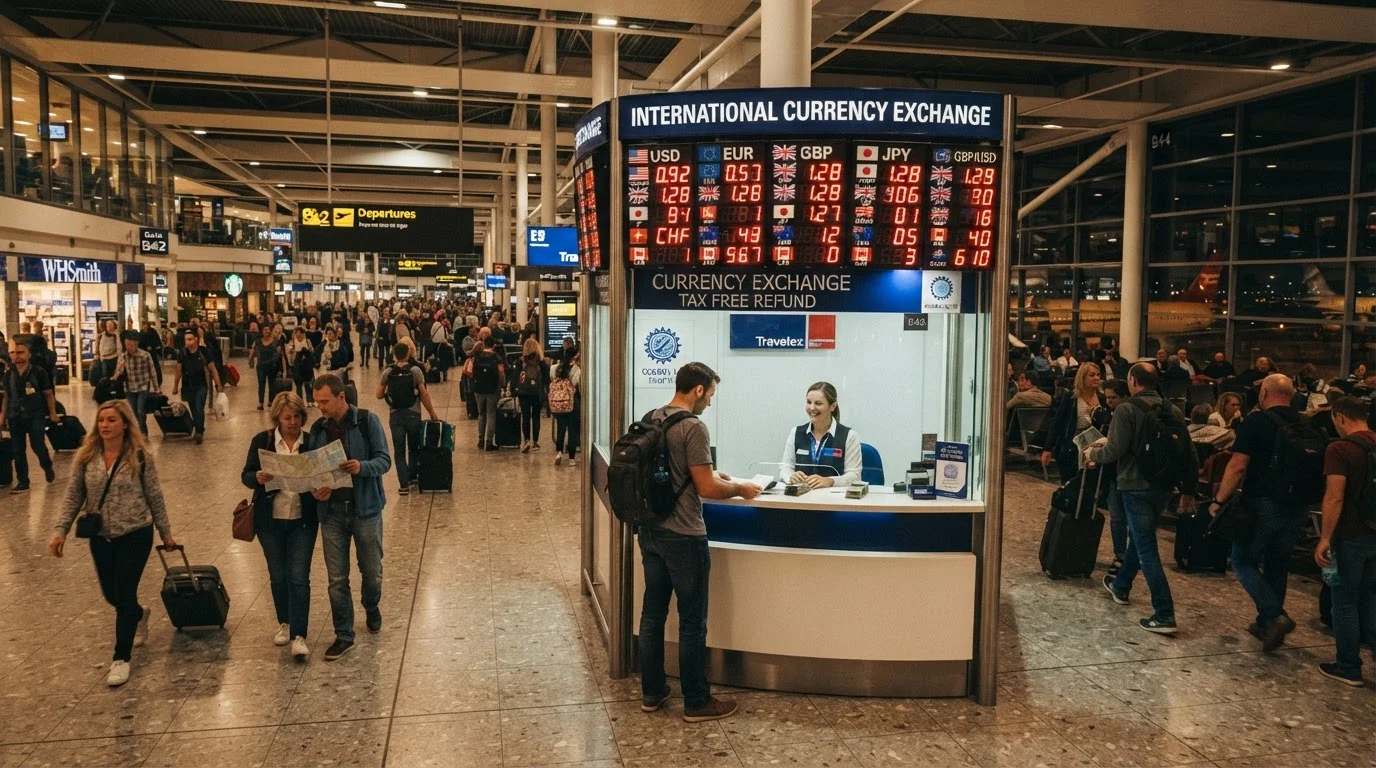
Airport currency desks exist to serve travelers at their most time-pressured moment. That convenience has a price: markups of 8%-15% above the interbank rate are common at major U.S. international airports, and some operators layer flat service fees on top. The rate boards may display competitive-sounding numbers, but the margin is typically built into the spread rather than shown as an explicit fee.
The practical guidance: if you need local currency the moment you land, limit airport exchange to a small amount - enough for a taxi and a meal - then switch to a local ATM for the rest of your trip.
Bank Branches at Home
Ordering foreign currency through your U.S. bank branch before departure usually yields rates better than airport desks, though still not as favorable as ATM withdrawals abroad. Margins typically fall in the 3%-6% range above the interbank rate. Some banks waive service fees for account holders; others charge $5-$15 per order. Delivery timelines (often 3-7 business days for less common currencies) limit this option for last-minute planners.
Bank branches are most useful for currencies that are difficult to source at ATMs in-country - certain African, Middle Eastern, or restricted-market currencies. For common destinations in Europe, Latin America, or Southeast Asia, this option is rarely the most efficient.
Local ATMs at the Destination
Withdrawing cash from a local ATM in your destination country typically delivers the narrowest spread - often 0.5%-2% above the interbank rate, before any flat fees. The ATM network (Visa/PLUS or Mastercard/Cirrus) performs the conversion using its daily wholesale rate, which is generally more competitive than any retail desk.
The catch: flat ATM fees add up on small withdrawals. A $5 foreign ATM fee on a $50 withdrawal equals 10% cost; the same fee on a $250 withdrawal drops to 2%. Withdraw larger amounts, less frequently. If your bank account reimburses international ATM fees, this option becomes even more attractive. For step-by-step guidance, see using ATMs safely and cheaply in foreign countries.
Maximize ATM Value With One Simple Rule
Before each withdrawal abroad, calculate your per-transaction fee as a percentage of the amount. Aim for flat fees to represent no more than 2%-3% of the total withdrawn. If your bank charges $5 per withdrawal, that means withdrawing at least $165-$250 per visit. Combine this with a bank account that reimburses foreign ATM fees and you'll consistently access rates closer to the interbank benchmark than any other method.
Hidden Costs to Watch Across All Three Options
Rate markups are only part of the story. Dynamic currency conversion (DCC) - where a foreign ATM or merchant offers to charge you in U.S. dollars rather than local currency - can add another 3%-7% on top of whatever channel you're using. Always choose to be charged in the local currency. See how dynamic currency conversion works and when to decline it for more detail.
Cards are also part of the equation. Depending on your card type, foreign transaction fees of 1%-3% may apply on top of ATM or exchange costs. Prepaid travel cards versus debit cards outlines how these products stack up for international use. For a broader framework on managing all of these costs together, the guide on managing money across borders without losing it to fees is a useful companion.
Never Exchange Everything at the Airport
Exchanging a large sum at an airport currency desk - even when rates appear posted clearly - can mean losing $50-$100 or more on a $1,000 conversion compared to a local ATM. The posted rate is often not the rate you receive once the spread is applied to your specific transaction amount. Treat airport desks as an emergency fallback, not a primary strategy.
Exchange rates, fees, and bank policies change frequently. Always verify current terms with your financial institution and check official government sources for any destination-specific currency restrictions before you travel. This article provides general information and does not constitute financial advice.