
How Each Card Works Overseas
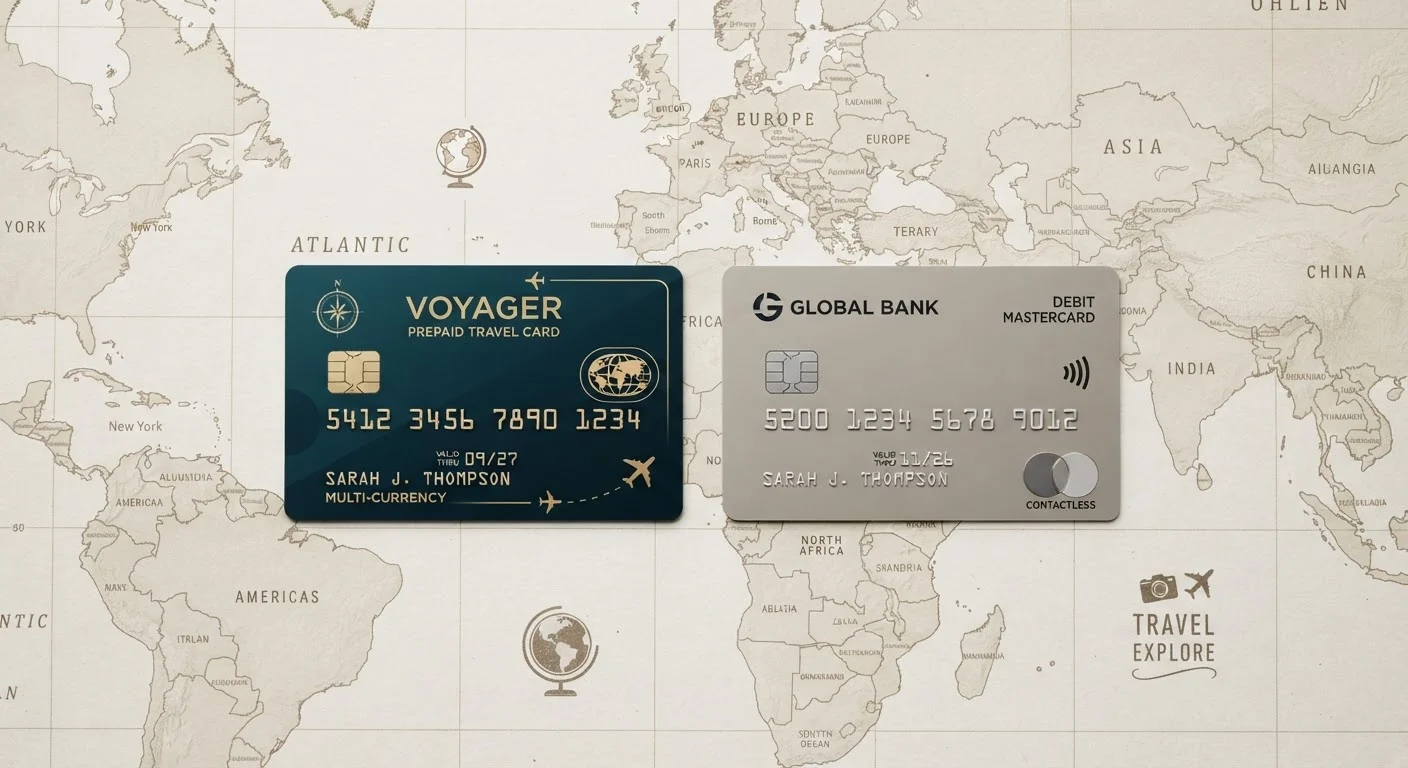
A prepaid travel card is funded in advance - you load a set amount of money, often in one or more currencies, before your trip. When you spend, you draw down that loaded balance. Most are issued on major payment networks and accepted wherever those networks operate. Some allow you to lock in an exchange rate at the time of loading, which means you know exactly what you paid in U.S. dollars regardless of what markets do later.
An everyday debit card draws directly from your checking account in real time. When you make a purchase abroad, your bank converts the transaction from the local currency to USD - typically using an interbank or proprietary exchange rate - and then applies any applicable foreign transaction fee on top. The convenience is real: no pre-loading required, and you can access your full account balance. The cost exposure, however, is equally real.
Understanding this structural difference is the foundation of any honest cost comparison. As a complement to card strategy, see when cash is smarter than cards abroad for scenarios where neither card type is optimal.
Fee Structures: Where the Costs Actually Hide
Foreign transaction fees on standard debit cards typically range from 1% to 3% of each purchase. On a $3,000 trip, that's $30-$90 gone purely to fees - before accounting for ATM charges. ATM withdrawals abroad often carry a flat fee from your home bank (commonly $3-$5 per transaction) plus a separate fee charged by the foreign ATM operator, which can reach $5 or more per withdrawal.
Prepaid travel cards have their own fee architecture. Common charges include: a card issuance fee, a currency loading fee or margin built into the exchange rate, ATM withdrawal fees (sometimes per transaction, sometimes monthly), and inactivity fees if the card sits unused. Some prepaid cards also charge fees to reload funds mid-trip.
| Criterion | Prepaid Travel Card | Everyday Debit Card |
|---|---|---|
| Foreign transaction fee | Often none (margin built into rate) | Typically 1%-3% per transaction |
| ATM withdrawal fee | Varies; often $2-$5 flat | Varies; $3-$5+ plus foreign ATM fee |
| Exchange rate control | Can lock in rate at loading | Rate set at point of sale by bank |
| Fraud exposure | Limited to loaded balance | Full checking account at risk |
| Merchant acceptance | Broad but some hold-based limitations | Broad; widely accepted internationally |
| Reload flexibility | Requires advance planning; fees may apply | No reload needed; draws live balance |
| Setup effort | Must obtain and load before travel | No extra setup; use existing card |
The practical takeaway: neither card is inherently cheaper. What matters is the specific fee schedule of the card you're evaluating versus the total volume and pattern of your overseas spending. Common travel money myths - including the idea that prepaid cards automatically save you money - are worth examining before assuming one option is superior.
Exchange Rates and Currency Risk
Exchange rates are where prepaid travel cards can offer a genuine structural advantage - or a subtle trap, depending on how you use them.
When you load a prepaid card in a foreign currency, you're essentially buying that currency at today's rate. If the USD weakens before your trip, you've protected yourself. If it strengthens, you've locked in a less favorable rate. Most prepaid card providers apply a margin of 0.5%-2.5% above the mid-market rate at loading - this is how they make money on the conversion, even when they advertise "no foreign transaction fees."
Everyday debit card conversions happen at the point of sale and are set by your bank's exchange rate policy, which also typically includes a margin above the mid-market rate - and then the foreign transaction fee on top. Some banks do offer mid-market or near-mid-market rates with no markup for customers on specific account tiers.
1%-3%
Typical foreign transaction fee on standard debit cards
Consumer financial guidance from the U.S. Consumer Financial Protection Bureau (CFPB) notes that foreign transaction fees are common on many bank-issued debit cards and can compound significantly on extended trips.
$5+
Common combined ATM fee per foreign withdrawal
International ATM withdrawals frequently incur both a home-bank flat fee and a separate operator fee charged by the foreign ATM, with combined costs routinely exceeding $5 per transaction.
0.5%-2.5%
Typical exchange rate margin on prepaid travel card loads
Prepaid card providers commonly apply a margin above the mid-market interbank rate when converting USD to a foreign currency, effectively embedding a fee into the loaded amount.
For ATM withdrawals specifically, the rate differences between ATM types and locations can be just as consequential as the card you use. Always decline the ATM's offer to convert for you (a practice called Dynamic Currency Conversion, or DCC) - it nearly always applies an unfavorable rate.
Security, Access, and Practical Limitations
From a fraud-risk standpoint, prepaid travel cards offer meaningful protection: if a card is skimmed or stolen, only the loaded balance is at risk - not your entire checking account. Recovery processes vary by issuer, but the financial ceiling on loss is lower than with a linked debit card.
Everyday debit cards connected to your primary account carry more exposure. Many banks offer strong fraud protections and quick dispute resolution, but the immediate impact of a compromised card - including a frozen account - can disrupt daily access to funds while traveling.
Access is a practical consideration too. Some prepaid travel cards are not accepted at all merchants (particularly those that place holds, like car rental companies or hotels), and reloading mid-trip can be cumbersome if you underestimate spending. Debit cards tied to major networks generally have broader acceptance.
For ATM-heavy itineraries, see how to use foreign ATMs safely and affordably - the withdrawal strategy matters as much as the card type. And if you're evaluating destinations based partly on cost, the range of affordable international destinations for U.S. travelers may help frame where card fees will feel more or less significant relative to overall daily spend.
This article is for general informational purposes only and does not constitute personalized financial advice. Fee structures, exchange rates, and card terms vary by issuer and change over time. Always verify current terms directly with your card provider and consult official government sources for entry and travel requirements before departing.