
What Dynamic Currency Conversion Actually Does
When you use a credit or debit card outside the United States, most payment terminals process the charge in the local currency - euros, baht, pesos - and your card issuer converts it to U.S. dollars using its own exchange rate. Dynamic currency conversion (DCC) intercepts that process. Instead of letting your bank do the conversion, it hands the job to the merchant's payment processor, who sets their own rate.
That rate is virtually always worse than what your bank would apply. The DCC provider builds a markup into the exchange rate - often between 3% and 12% above the mid-market (interbank) rate - and the merchant may receive a share of that margin as an incentive to push the service. The traveler, presented with a prompt framed around "convenience" and "certainty," often agrees without realizing there's a financial cost attached.
For a deeper look at how this fits into the broader landscape of international card fees, see our traveler's glossary of foreign transaction fees and currency markups.
3-12%
Typical DCC markup above mid-market rate
Consumer finance research and card industry analyses consistently place DCC surcharges in this range, though individual transactions may vary.
~$12-$48
Extra cost on a $400 international purchase
Illustrative estimate based on a 3-12% DCC markup applied to a single mid-size travel expense such as a hotel night or tour booking.
1-3%
Typical foreign transaction fee on U.S. cards
Standard foreign transaction fees charged by many U.S. card issuers - generally lower than most DCC markups even when both apply.
Where You'll Encounter the DCC Prompt
DCC appears wherever international card payments are accepted - and that's nearly everywhere. Common trigger points include:
- Airport shops and duty-free counters, where travelers are often rushed and distracted
- Hotel front desks, especially at checkout when you're focused on getting to your next destination
- Restaurant point-of-sale terminals that are handed to you tableside
- ATMs operated by private networks rather than local banks
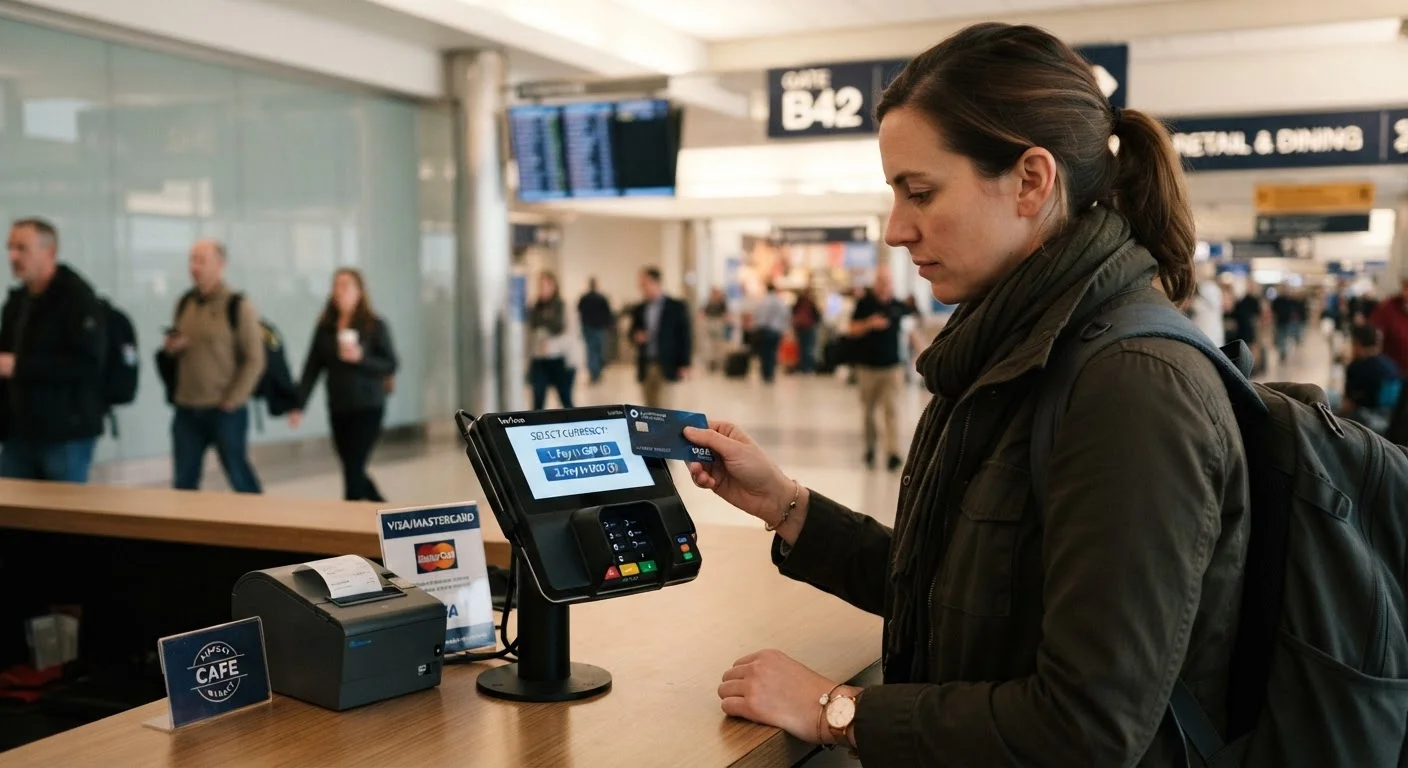
The airport environment is particularly high-risk for DCC acceptance. Travelers are often fatigued, time-pressured, and dealing with unfamiliar currency amounts - conditions that make it easy to tap "confirm" without reading the screen. Independent ATMs in airport arrivals halls are frequent DCC offenders.
This connects to a broader pattern of costs that erode travel budgets without travelers noticing. Our guide on why travelers lose money on currency exchange without realizing it covers the full picture.
Make 'Local Currency' Your Default Response
Before every international card transaction, glance at the currency shown on the terminal screen. If it displays your home currency (USD) rather than the local one, decline and ask for local currency. Building this habit takes seconds and can save you a meaningful percentage on every purchase. For smoother airport experiences overall, see our airport and flight hacks.
How to Decline It - Every Time
Declining DCC is straightforward once you know what to look for. The key rule: always choose to pay in the local currency. If a terminal shows you an amount in U.S. dollars and offers to charge that exact amount, that is DCC. Select the option that shows the local currency instead.
At ATMs, the prompt typically appears after you enter your PIN and request a withdrawal amount. The machine may phrase it as "Would you like to be charged in USD?" or display a pre-selected home-currency option. Choose the local currency and proceed. Some ATMs make the local-currency button visually smaller or less prominent - look carefully before confirming.
If a cashier says they'll "convert it for you" or asks which currency you prefer, say clearly: "Local currency, please." Under Visa and Mastercard rules, merchants are required to give you the choice and disclose the rate - though enforcement is imperfect and varies by country.
After any international trip, review your card statements and look for charges where the USD amount seems high relative to what you spent. This can help you spot cases where DCC was applied, possibly without a clear opt-in. For context on how exchange-rate decisions affect your overall costs, see how airport currency exchanges, bank branches, and local ATMs compare on rates.
Keeping DCC in the Context of Your Broader Travel Budget
DCC is one of several quiet costs that chip away at international travel budgets - alongside foreign transaction fees, ATM withdrawal charges, and poor exchange timing. None of them individually feel catastrophic, but together they can meaningfully reduce the value of your travel spending.
If your card charges a foreign transaction fee (typically 1-3%), paying in local currency still triggers that fee. However, a 3% foreign transaction fee is almost always lower than a DCC markup on top of your bank's rate. The math generally favors local currency even on cards that aren't fee-free.
Travelers managing multiple currencies across a longer trip have additional exposure to these conversion costs - our piece on the trade-offs of carrying multiple currencies on a multi-country trip addresses how to think through that complexity. And for a fuller inventory of the overlooked charges that catch budget travelers off guard, see the hidden costs that eat your budget abroad.
Exchange rates, fee structures, and merchant practices vary by country and card issuer. Always verify current terms with your card provider and check official travel guidance before your trip. This article is for general informational purposes and does not constitute financial advice tailored to your individual situation.