
Why Accommodation Safety Deserves a Systematic Approach
For solo travelers, lodging is more than a place to sleep - it's your base of operations and, when you close the door, your primary layer of personal security. Unlike group travelers who can rely on each other for awareness, solo travelers carry that responsibility alone. That makes a structured evaluation habit genuinely valuable, not paranoid.
The good news is that most safety gaps in accommodation are visible and fixable once you know what to look for. This guide walks you through that process, from pre-booking research to nightly routine. If you're newer to traveling alone, our foundational solo safety guide covers the broader principles that underpin everything here.
For context on how your accommodation type affects your risk profile, see the safety trade-offs between hostels and private rooms.
What you will need
What You'll Need
Most of what makes lodging safer costs nothing - it's attention and habit. A few low-cost tools can close gaps that attention alone can't address.
Portable door wedge alarm
Wedges under the door to prevent it opening; alarm sounds if pressure is applied - adds a layer of in-room security.
Small flashlight or phone torch
Useful for checking dark corners, poorly lit corridors, and locating emergency exits at night.
Luggage padlock
Secures your bag to a fixed object in shared dorms or when using an in-room locker.
For budget-focused guidance on choosing between accommodation types in the first place, this comparison of hostels, guesthouses, and solo-friendly hotels weighs cost, safety, and social value side by side.
Step-by-Step: Evaluating Your Lodging
Follow these steps in order - some are done before you arrive, others at check-in, and a few become nightly habits.
Research the property before you book
Don't rely solely on the accommodation's own photos and descriptions. Cross-reference reviews on at least two platforms, filtering specifically for solo travelers' experiences. Look for recurring mentions of security - working locks, 24-hour reception, well-lit entrances - as well as red flags like staff who share guests' room numbers loudly, poor lighting in corridors, or broken door hardware that went unaddressed.
Check where the property sits relative to the neighborhood. A quick look at a map and local travel forums can tell you whether the surrounding streets are considered safe after dark.
Assess the entrance and reception area on arrival
Before you head to your room, spend two minutes observing the common areas. Is the entrance well-lit and secure? Does it require a key card or code after hours? Note whether staff are attentive and whether the front desk is positioned to monitor who enters and exits. A desk tucked away at the back with no sightline to the door is a meaningful gap in oversight.
Ask directly: what time does the main entrance lock? How do guests get back in after hours? A property that has clear, practiced answers to these questions is a good sign.
Inspect your room immediately after check-in
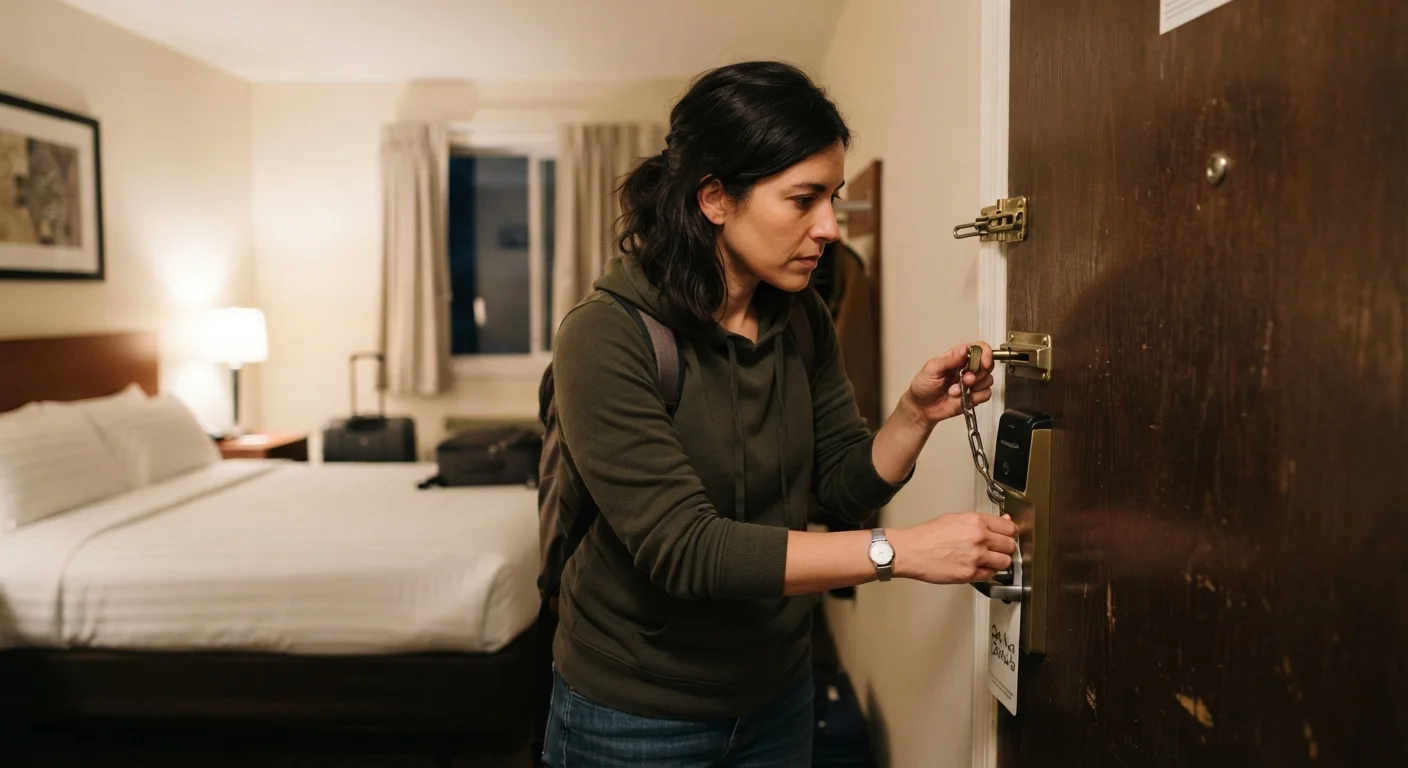
Do this before unpacking anything. Check the deadbolt and door chain or latch - both should engage smoothly and hold firmly. Test the peephole. Inspect all windows: do they lock? If your room is on the ground floor or accessible from an exterior walkway, functional window locks are non-negotiable. Check the connecting door if there is one - it should lock from your side.
Look at the overall layout: is there a clear path to the door if you needed to leave quickly in the dark?
Locate emergency exits and understand the fire plan
Walk the corridor outside your room and find the nearest stairwell exit. Count the doors between your room and the exit - you may need to navigate in low visibility. Check whether the fire escape routes are clearly posted. This takes less than five minutes and is one of the most consistently overlooked safety steps.
Set up your in-room security layer
Use all available locking mechanisms every time you're in the room - deadbolt and chain, not just the handle lock. If you've brought a portable door wedge, place it at night. Store valuables in an in-room safe if one exists, or keep them in a locked bag. In shared dorms, use a padlock on any provided locker and keep your bag secured to a fixed object when you sleep.
Establish a check-in routine with a trusted contact
Let someone at home - a friend, family member, or travel companion - know where you're staying and a rough daily check-in schedule. A simple message confirming you're in for the night takes seconds and creates a meaningful safety net. If you miss a check-in, they know to follow up. This is especially important when staying somewhere new or in an unfamiliar city.
Build the Habit, Not Just the Checklist
Running through these steps once is useful; doing them automatically every time you check in is what builds real safety competence. It takes about three or four stays before the routine feels natural. After that, it adds less than ten minutes to your check-in and becomes second nature.
How much information you share at the front desk also matters. Giving out your room number to casual acquaintances or being overheard discussing your solo status are low-level but real risks. This guide on managing personal information as a solo traveler is worth reading alongside this one.
Recognizing When to Move On
Not every issue can be fixed with a door wedge. If broken security hardware isn't addressed after a reasonable request, if the property feels consistently unsupervised, or if your gut is signaling something you can't quite articulate - trust it. Leaving a booking is inconvenient and sometimes costly, but it's rarely as costly as staying somewhere that makes you genuinely uncomfortable.
Keep a backup option identified before you check in: a nearby alternative property, a quick-access map of your neighborhood, and your accommodation platform's support contact. This preparation costs you ten minutes and removes the panic from the decision if you need to act on it.
When Staff Behavior Is the Red Flag
Occasionally, safety concerns originate with staff rather than infrastructure. If a staff member announces your room number audibly, asks intrusive personal questions, or makes you feel watched or uncomfortable, report it to a manager immediately and document it. If the response is dismissive, escalate with the booking platform. Your comfort with the people managing your accommodation matters as much as the hardware on the door.
Accommodation safety is one piece of a broader planning approach. For the full picture, this overview of solo travel safety planning covers the considerations that genuinely matter without unnecessary alarm.