Run through this practical checklist before any solo trip — from emergency contacts to digital backups — so nothing critical gets overlooked.
Key Takeaways
Share a detailed itinerary with at least one trusted contact before departure.
Store digital and physical copies of all critical documents separately from originals.
Verify visa, entry, and health requirements through official government sources - not travel forums.
Set up a regular check-in schedule so someone back home knows when to raise an alert.
Confirm travel insurance covers your specific destinations, activities, and medical evacuation.
Why a Pre-Departure Safety Checklist Matters
Solo travel removes the built-in safety net of a travel companion. There's no one to remind you that your passport expires in two months, notice you forgot to share your hotel address, or flag that the trail you're planning requires a permit. That gap is exactly what a structured pre-departure routine closes.
This checklist is organized by category - documents, communications, digital prep, health, and on-the-ground logistics - so you can work through it systematically rather than relying on memory. For a broader look at what genuinely moves the needle on solo safety, see our solo travel safety planning guide. For a parallel checklist focused on finances and insurance before departure, the pre-departure budget checklist covers that ground directly.
Documents & Entry Requirements
Verify your passport is valid for at least six months beyond your return date and has sufficient blank pages.Must
Confirm visa requirements for every country on your itinerary using that country's official embassy or consulate website.Must
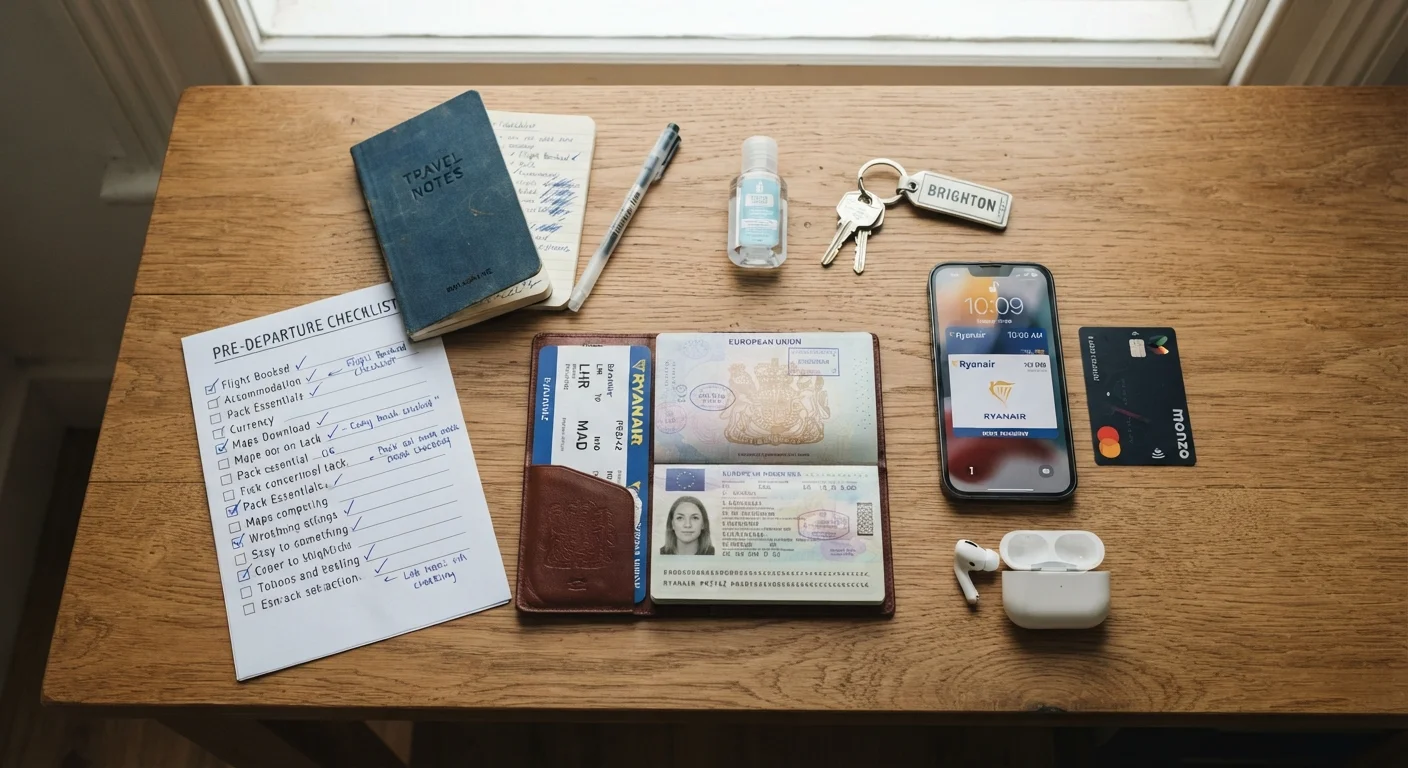
Make two physical copies of your passport, visa, travel insurance policy, and emergency contacts - store one separately from originals.Must
Upload scanned copies of all critical documents to a secure, encrypted cloud location you can access from any device.Must
Check whether your destination requires proof of onward travel or a return ticket at the border.Should
Emergency Contacts & Communication Plan
Share a detailed itinerary - including accommodations, transport bookings, and activity plans - with at least one trusted contact at home.Must
Agree on a check-in schedule (frequency, preferred channel, and a clear protocol if you miss one) with your emergency contact.Must
Write down local emergency numbers (police, ambulance, fire) and your country's embassy or consulate contact for each destination.Must
Enroll in your government's traveler registration program (e.g., the U.S. Department of State's STEP program) so the embassy can reach you in an emergency.Should
Identify a secondary contact who can act on your behalf at home if your primary contact is unreachable.Should
Health & Insurance
Confirm your travel insurance policy covers medical treatment, evacuation, and your planned activities - including any adventure sports.Must
Check destination-specific health requirements and recommendations with your healthcare provider and the CDC's travel health notices at least four weeks before departure.Must
Pack a sufficient supply of any prescription medications, plus a written prescription from your doctor in case you need a refill abroad.Must
Note the nearest hospital or clinic to each accommodation and save the address offline.Should
Confirm your insurance policy number, 24-hour claims line, and coverage limits are written down and stored separately from your phone.Should
Digital Security & Device Prep
Enable full-device encryption and a strong lock screen PIN or biometric lock on your phone and laptop.Must
Back up your phone and laptop to a secure location so you can restore your data if a device is lost or stolen.Must
Download offline maps, translation tools, and your accommodation addresses before departure - do not rely solely on live internet access.Should
Enable remote-wipe functionality on your phone so you can erase it if stolen.Should
Notify your bank and credit card issuers of your travel dates and destinations to avoid having cards blocked mid-trip.Nice to have
Accommodation & On-the-Ground Logistics
Confirm your first night's accommodation booking and save the address, check-in instructions, and host contact number offline.Must
Research local transportation from your arrival point to your accommodation, including approximate cost and any known scam routes.Should
How to Use This Checklist
Work through each group at least 72 hours before departure - not the night before your flight. Some items (passport validity, visa applications, insurance enrollment) have lead times that can't be compressed.
Don't Rely on Memory for Entry Requirements
Visa rules, vaccination requirements, and entry restrictions change without much public notice. Always verify current requirements directly through the official embassy or consulate website for each destination - not travel blogs, forums, or third-party aggregators. Arriving with incorrect documentation can mean denial of boarding or entry at the border.
Print the checklist or save it offline. The irony of a digital safety checklist is that it's useless if your phone dies or you lose signal mid-process. For a full reference of what to write down and store offline, see the information every solo traveler should have written down.
Finally, a check-in routine is only as good as the system supporting it. Communication strategies that keep solo travelers accountable offers practical templates for setting expectations with people back home without turning check-ins into a burden.
Your Emergency Contact Needs the Full Picture
Sharing a rough itinerary isn't enough. Your emergency contact should have your policy number, insurance company's 24-hour line, passport number, and a clear agreement on what to do if they don't hear from you. A contact who doesn't know what action to take - or when - isn't an effective safety net. Take 15 minutes before departure to walk them through the plan explicitly.
Solo Travel Editorial Team is the collective byline for our editorial team and contributor network. Articles published under this byline or an editorial pen name are researched, written, and reviewed according to our editorial standards for clarity, consistency, and independence before publication.
The content on this site is for informational purposes only and is not a substitute for professional advice. Always consult a qualified professional for guidance specific to your situation.