
The Hidden Cost Structure of Currency Exchange
Most travelers focus on the exchange rate displayed on a board or screen - but that number rarely tells the full story. Currency exchange is a layered system of markups, flat fees, and commissions that work together to widen the gap between what you hand over and what you actually receive. Understanding this structure is the foundation of spending smarter abroad.
Every currency transaction has a reference point called the mid-market rate - the midpoint between the global buy and sell prices for a currency pair at any given moment. No retail exchange service offers this rate to consumers; they all build in a margin. The question is how wide that margin is and how transparently it's disclosed. For a deeper breakdown of the terminology involved, see this plain-language glossary of travel money fees.
The mistakes below aren't obvious errors - they're patterns that feel reasonable in the moment but quietly erode your budget over the course of a trip.
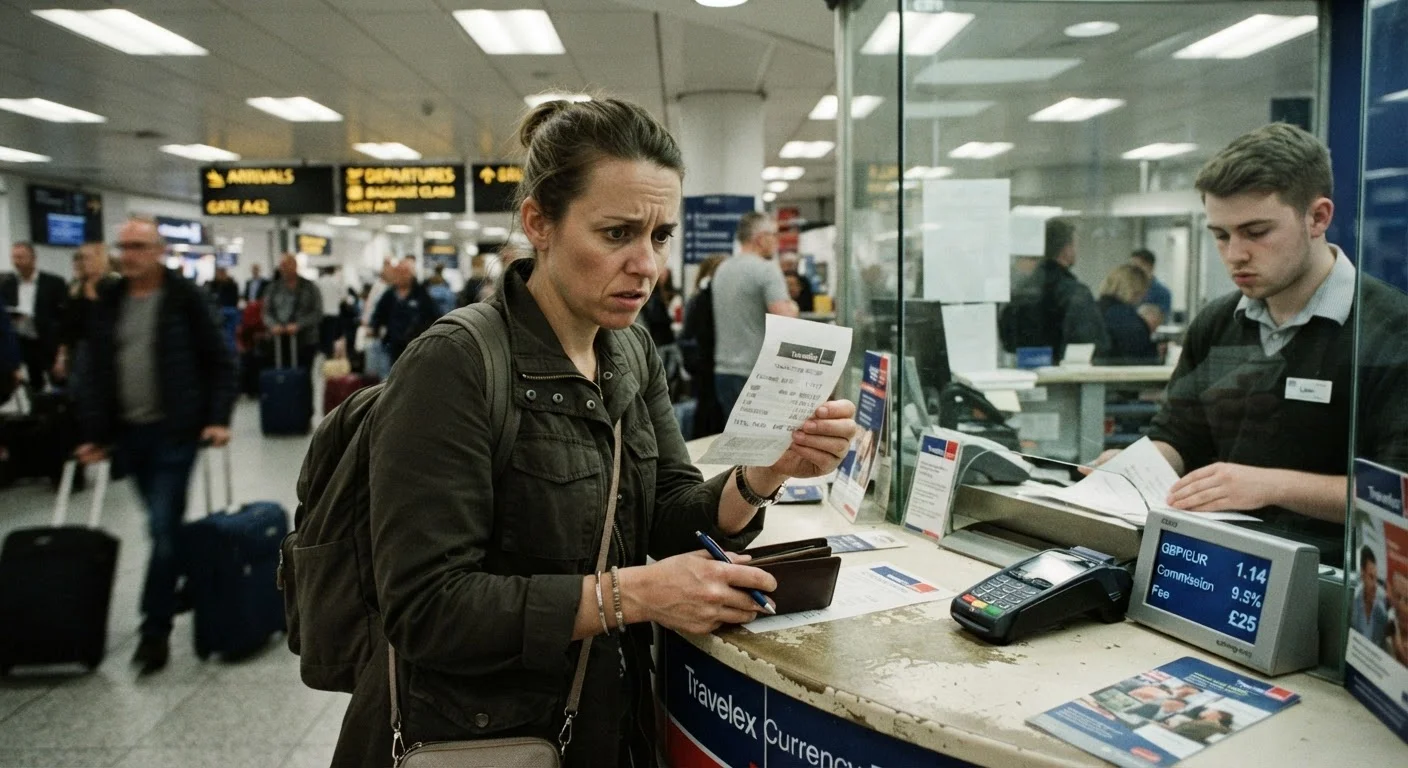
Exchanging currency at the airport on arrival or departure.
Why it happens: Airport exchange desks are the first option travelers see after landing, and urgency overrides research. Departing travelers often have leftover cash and reach for the nearest counter without comparing rates.
Accepting dynamic currency conversion (DCC) at card terminals.
Why it happens: Card terminals abroad frequently offer to charge your card in your home currency rather than the local one. The prompt is framed as a convenience, and travelers accept it without realising it locks in a retailer-set exchange rate - typically 3-8% worse than what their own card would apply.
Making frequent, small ATM withdrawals instead of fewer, larger ones.
Why it happens: Travelers underestimate how much cash they'll need day to day and return to ATMs repeatedly. Each withdrawal feels small, so the flat fee - often $3 to $7 per transaction from your home bank, plus a local ATM operator fee - doesn't register as significant.
Carrying only one payment card with no fee-free alternative.
Why it happens: Most travelers pack the card they use at home without checking whether it charges foreign transaction fees - typically 1-3% per purchase. They also don't anticipate that a single card can be frozen by fraud detection systems, leaving them without access to funds.
Exchanging currency at hotels or tourist-facing exchange booths.
Why it happens: These locations market themselves on convenience and visibility. Travelers in unfamiliar cities default to the nearest or most prominently signed option without verifying the rate they're being offered.
How These Mistakes Compound Over a Trip
Each individual exchange mistake might cost $5 to $15 in isolation. Across a two-week international trip - with multiple ATM withdrawals, a few card transactions at tourist-oriented businesses, and a currency exchange at the airport on departure - the cumulative loss can easily exceed $80 to $120. That's money that could cover a full day of food and local transport in many destinations.
3-8%
Typical DCC markup over card rate
Dynamic currency conversion markups commonly range from 3% to 8% above what your card's own exchange rate would apply, according to consumer financial guidance published by multiple European banking regulators.
$5-$7
Average combined ATM withdrawal fee abroad
When a traveler's home bank fee and a foreign ATM operator fee are combined, the average total per withdrawal frequently falls in the $5-$7 range for U.S. account holders, based on widely cited retail banking fee surveys.
The pattern tends to worsen because travelers often don't notice the losses in real time. You're converting unfamiliar denominations, managing logistics, and spending in a context where prices already feel abstract. This mental distance is exactly why travelers consistently underestimate their daily spending - the friction of foreign currency masks the true cost of each decision.
Pairing smarter exchange habits with a broader awareness of overlooked costs pays dividends. The hidden costs that erode budgets abroad - including resort fees and tourist taxes - stack on top of exchange losses, not independently of them. Addressing both together gives you a far more accurate picture of what a trip will actually cost.
"No Commission" Doesn't Mean No Cost
Exchange services that advertise zero commission or no fees often recoup their margin entirely through a wider spread - the gap between the rate they buy currency at and the rate they sell it to you. The headline claim is technically accurate but financially misleading. Always calculate the effective rate against the mid-market benchmark rather than taking fee-language claims at face value.
This article provides general financial information for educational purposes only. Exchange rates, fee structures, and card policies vary by provider and change frequently. Always verify current terms with your bank, card issuer, and official government sources before traveling. This content is not personalised financial advice.