
The Building Blocks of a Ticket Price
Strip a flight ticket down to its components and you find three distinct layers: the base fare, government taxes and airport fees, and carrier-imposed surcharges. Each behaves differently and responds to different forces.
The base fare is the airline's own charge for transporting you from A to B. This is the part that fluctuates - sometimes dramatically - based on demand, competition, and inventory. It can represent less than half the total ticket price on some international routes.
Government taxes and airport fees include the U.S. Federal Excise Tax (7.5% on domestic fares), Passenger Facility Charges (PFCs) collected by airports, and security fees. These are largely fixed and non-negotiable. For a detailed breakdown of what airport charges actually fund, see what each airport fee actually covers.
Carrier-imposed surcharges - sometimes labeled YQ or YR on itineraries - are fees airlines add separately from the base fare. Originally tied to fuel costs, these surcharges have evolved into a revenue mechanism that persists even when fuel prices fall. They are not regulated the same way as government taxes, giving airlines flexibility in how they apply them.
~30%
Average share of a ticket that is taxes and fees
Industry analysis has consistently found that government taxes, airport charges, and carrier surcharges account for roughly a quarter to a third of total ticket cost on many U.S. domestic and international routes.
Hourly
Frequency of airline fare updates
Airline pricing systems are capable of updating fares multiple times per hour in response to inventory changes, competitor moves, and demand signals - not once per day as many travelers assume.
20-26
Typical number of fare classes in a single cabin
Most major carriers use between 20 and 26 lettered fare classes in economy alone, each with distinct pricing, rules, and inventory allocation - a structure that produces the price variation travelers see.
How Yield Management Drives Price Changes
The engine behind airfare volatility is yield management - a revenue optimization strategy airlines have used since the 1980s. The core idea: a single flight has a fixed number of seats, each of which is worth nothing once the plane departs. The goal is to sell every seat at the highest price the market will bear.
Airlines divide their inventory into fare classes - buckets of seats, each priced differently and governed by different rules (advance purchase requirements, refundability, change fees). As lower-priced buckets fill, higher-priced ones open. This is why a fare that costs $189 on Monday might show $310 on Thursday - not because the airline changed its mind, but because the cheaper inventory ran out.
Modern systems layer machine learning on top of this structure, adjusting prices in near-real time based on competitor pricing, search traffic, historical booking patterns by route and season, and current pace of bookings relative to forecasts. For a closer look at how this plays out from the moment you search, see what actually happens between a search and a purchase.
“Yield management is probably the most important technical development in transportation management since we entered the era of deregulation. We estimate it generates $500 million in incremental revenue annually.”
— Robert Crandall, Former CEO, American Airlines - widely credited with pioneering yield management in commercial aviation
The Three Demand Signals Airlines Watch Most Closely
Not all demand is equal in an airline's pricing model. Three signals carry the most weight:
- Booking lead time. Airlines model expected demand curves for every flight. If bookings are running ahead of forecast with 60 days to go, prices rise to protect seats for higher-paying late bookers. If the flight is underselling, discounts may open up - though airlines increasingly prefer to cancel undersold flights rather than discount deeply. Understanding this curve is the basis of the booking window concept.
- Day-of-week and time-of-day travel patterns. Flights popular with business travelers - early Monday mornings, Thursday evenings - are priced differently than leisure-heavy weekend departures. The same route at 6 a.m. Saturday versus 7 a.m. Monday can carry a significant price gap.
- Route competition. On routes served by multiple carriers, competitive pricing pressure keeps fares more elastic. On routes dominated by one or two airlines, fares tend to be stickier and higher. This structural reality means where you're flying matters as much as when.
These signals interact constantly. A route that's normally competitive can spike when a carrier reduces capacity for a season, tightening supply and removing downward pricing pressure.
What Travelers Often Misread About Price Swings
Several widespread beliefs about airfare pricing send travelers chasing strategies that don't hold up against how the system actually works. Common flight pricing myths - like the idea that incognito browsing hides your searches or that Tuesday is universally cheaper - persist because they're simple, not because they're accurate.
Price drops after booking are similarly misunderstood. When a fare falls after you've purchased, it's typically because the airline opened a new, lower fare class - often in response to slow booking pace or a competitive response. It's not a refund opportunity in most cases; it reflects a separate inventory decision. See what actually triggers a fare drop for the mechanics behind this.
Perhaps the most consequential misread is treating the advertised fare as the full cost. Seat selection fees, checked baggage charges, and change penalties are excluded from the base fare but materially affect total spend. How ancillary charges inflate the final price is a pattern worth understanding before you book, not after.
Check Flexible Date Views Before Committing
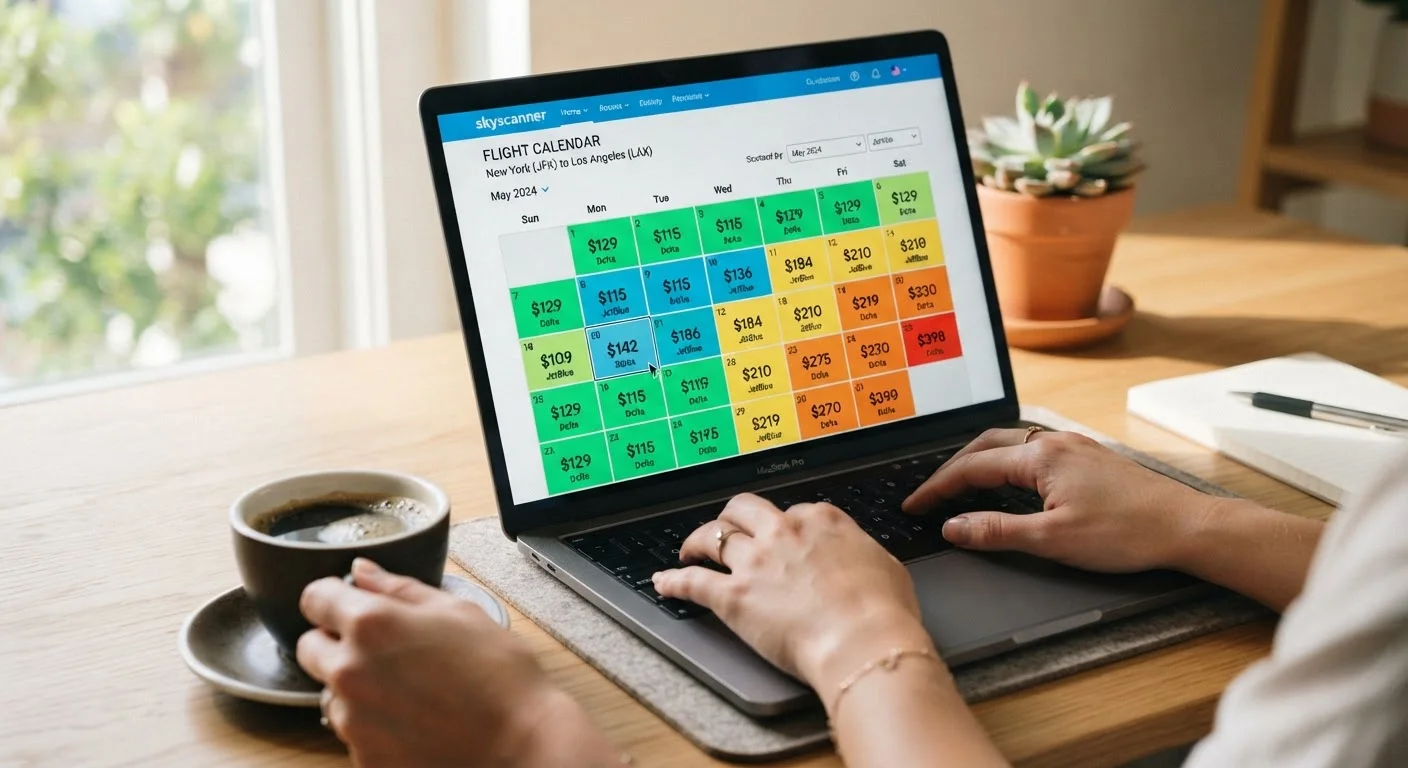
Most flight search tools offer a calendar or grid view showing fares across multiple dates. Use this before selecting specific travel dates - a one- or two-day shift in departure often crosses a fare class boundary and can yield meaningful savings. This is especially effective for leisure travel where exact dates are negotiable.
Using This Knowledge to Search More Effectively
Understanding the structure of airfare doesn't guarantee lower prices, but it removes the guesswork from when and how to search. A few principles follow directly from the mechanics above:
- Compare total cost, not base fare. Two fares that look identical at search may diverge significantly once seat and bag fees are included. Price at the basket level, not the headline number.
- Route structure affects price more than search timing. Switching from a nonstop to a one-stop itinerary, or departing from a secondary airport, often unlocks a lower fare class entirely - not just a small discount.
- Flexible date searches reveal fare class boundaries. Seeing prices across a week or month of departures shows you where inventory thresholds sit. A $40 gap between adjacent dates usually signals a fare class boundary, not random variation.
- Understand what you're comparing. The same itinerary priced through different channels may include or exclude different fees. Reading fare rules - especially around changes and bags - matters more than marginal price differences between platforms.
For broader strategies on how airlines decide pricing at the individual level, yield management and what it means for buyers provides a deeper look at the passenger-level picture.