
What the Booking Window Actually Measures
When researchers and revenue analysts talk about the booking window, they mean one thing: the number of days between ticket purchase and departure. A passenger who buys a ticket 60 days before flying has a 60-day booking window; one who buys at the gate has a window of near-zero. Airlines track this metric carefully because it tells them a great deal about who is buying and why.
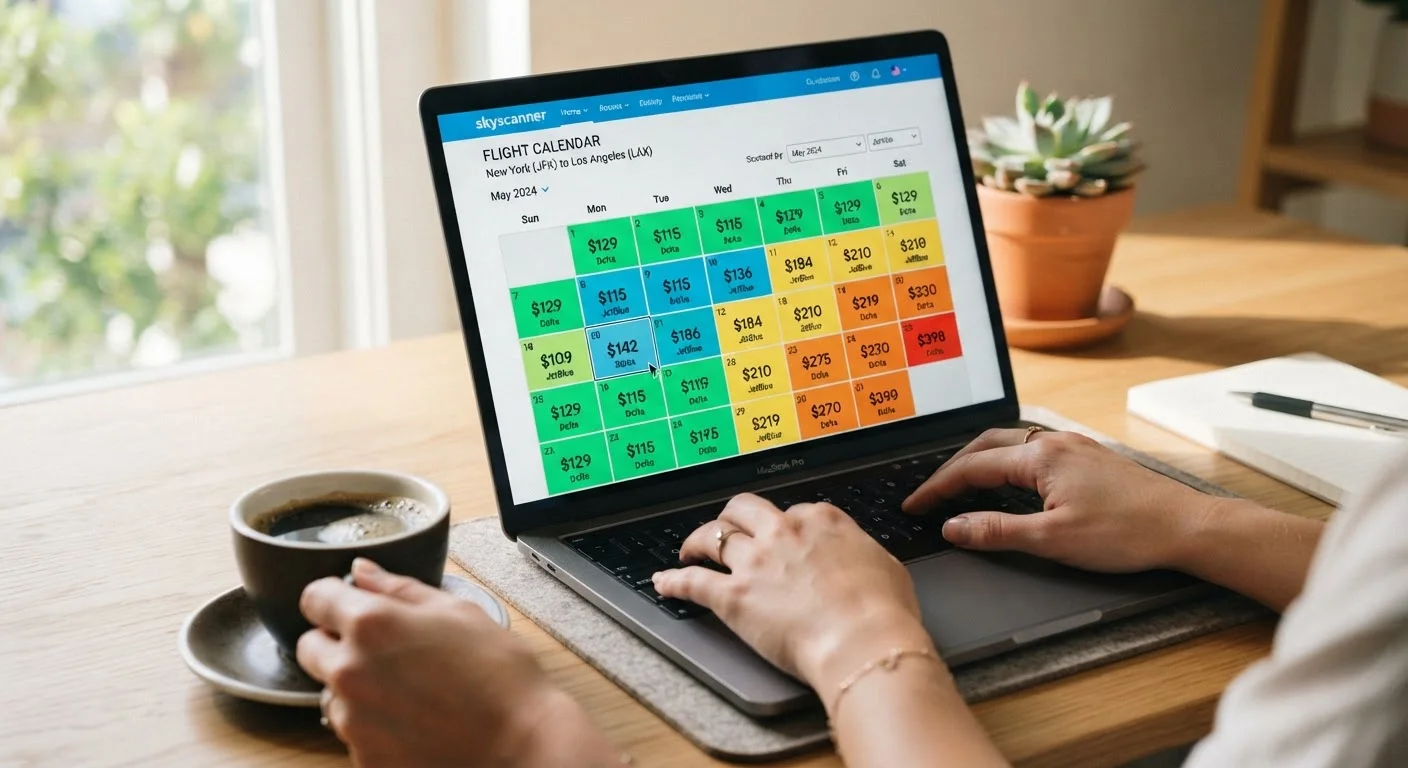
The booking window matters to travelers because fares are not priced in a vacuum - they are priced relative to how far out a given departure is and how fast the remaining seats are selling. That relationship is managed by automated revenue management software that adjusts prices across fare classes (the discrete price buckets airlines use internally) continuously. As lower-priced fare classes sell out, the system automatically opens higher ones, which is why a route that showed a low fare yesterday may show a significantly higher one today.
For a fuller picture of the forces behind these movements, see what drives airfare fluctuations.
~47 days
Cited domestic booking sweet spot
Travel analytics firms have historically pointed to roughly 47 days before departure as a general mid-range estimate for competitive domestic fares, though this varies significantly by route and season.
2-6 months
Common international booking lead time
Industry guidance generally suggests booking international long-haul travel two to six months in advance to access more competitive fare classes before peak inventory sells through.
~14 days
Last-minute price surge threshold
Fares on most routes tend to rise noticeably once a departure is within two weeks, as airlines shift yield management toward higher-revenue business and emergency travelers.
How Airlines Use Demand Curves to Set Prices Over Time
Airlines build demand forecasts for every route they operate. These forecasts estimate how many seats will sell at each price point and at each point in the booking window. The goal is to maximize total revenue per flight - not to fill every seat at the lowest possible price, and not to hold out for the highest price on every seat.
Early in the booking window (typically three to six months out for domestic, longer for international), airlines often release a portion of inventory at lower introductory fares to stimulate early purchases and establish a demand baseline. As the departure date approaches and the forecast is updated with actual booking data, the system recalibrates. If a flight is filling faster than expected, lower fare classes close earlier and prices rise. If demand is sluggish, discounts may persist deeper into the window.
The final 14 days before departure are almost universally the most expensive for leisure travelers. This is by design: airlines know this window is dominated by corporate and emergency bookings from passengers whose employers or circumstances are absorbing the cost. Seasonal demand cycles layer on top of this baseline, pushing prices higher around school breaks and holidays regardless of lead time.
“Revenue management is fundamentally about selling the right seat to the right customer at the right time for the right price. Time is not incidental to that equation - it is central to it.”
— Sheryl E. Kimes, Professor emerita of operations management, Cornell University School of Hotel Administration, whose research spans yield management across hospitality and travel industries
The Shape of a Typical Fare Curve
If you were to plot the average fare for a given seat on a single flight against the number of days remaining before departure, you would rarely see a straight line. The pattern more commonly resembles a shallow U or a reverse J: fares start moderately, can dip during a mid-window sweet spot, and then climb steeply in the final two weeks.
The mid-window dip - when it exists - reflects the overlap of two airline pricing goals: capturing early-commitment passengers and not leaving capacity unsold. Not every route or season produces a clear dip, and the exact timing shifts based on route length, carrier strategy, and how competitive the market is. On thin routes with few carriers, the pricing curve may be flatter and less forgiving. On heavily competed routes with multiple airlines, competitive pressure tends to keep mid-window fares more accessible.
This is why blanket rules like "always book Tuesday" or "always buy eight weeks out" are oversimplifications. They may have reflected patterns at a particular point in time on particular route sets, but revenue management systems are dynamic and routes differ enormously. See booking windows and price valleys for a more granular look at timing strategies by season.
Set a Price Anchor Before You Commit
Before tracking a fare over time, run your initial search far enough in advance to establish what a typical price looks like for your route and dates - ideally six to eight weeks out for domestic trips. This baseline makes it much easier to recognize whether a subsequent price is genuinely competitive or just appears low because you've been watching it fall from an unusually high starting point.
Practical Implications for Budget Travelers
Understanding the booking window reframes how you approach fare research. Rather than searching once and buying impulsively - or waiting indefinitely for a lower price that may never come - the more useful habit is to establish a price anchor early, then track movement over time.
Fare alert tools (built into most flight search engines) notify you when a tracked route crosses a price threshold you set. This removes the need for daily manual searches and gives you a data point: is the price moving up, down, or holding steady? If you observe prices rising on a route you need, that's a signal the window is closing. If they're flat or dipping, you have more flexibility to wait.
For complex itineraries, the booking window calculus becomes more involved. Multi-leg international trips may have different optimal windows for each segment, and domestic and international windows differ meaningfully. The core principle remains the same: the earlier you understand what a fair price looks like for your route, the better positioned you are to recognize it when it appears - and to act without second-guessing.
This article provides general information about airline pricing patterns and is not a guarantee of specific fares or savings. Prices vary by route, carrier, and date. Always verify current fares directly with airlines or accredited booking platforms before making travel decisions.