
From Algorithm to Search Result: The Chain Behind a Displayed Fare
When you search for a flight, you're not looking directly into an airline's inventory system. You're seeing a translated snapshot - pulled from a Global Distribution System (GDS) or an airline's own API - that a metasearch engine has assembled and ranked. By the time that fare appears on your screen, it has passed through at least two or three intermediary systems, each introducing a small lag.
Airlines themselves set prices inside Revenue Management Systems that recalculate fares continuously. These systems monitor how quickly seats are selling relative to historical booking pace, what competitors are charging on the same route, current load factors (the percentage of seats already filled), and time remaining to departure. The result is a fare that can - and does - change multiple times per day.
For a deeper breakdown of the forces driving those changes, see why airfare fluctuates so unpredictably.
168+
Fare changes per route per day (average)
Airlines' revenue management systems can update prices on a given route more than 168 times in a 24-hour period, according to research cited by airline industry analysts.
1-3 months
Domestic booking sweet spot before departure
Consumer travel data broadly indicates this window as the range where competitive domestic US airfares are most commonly accessible, balancing inventory availability against scarcity pricing.
~26
Fare buckets per flight (typical range)
A single domestic flight may have more than two dozen distinct fare classes, each with its own price point, seat count, and booking conditions managed by the airline's revenue system.
Fare Buckets: The Inventory System That Controls What You Pay
Every seat on a flight belongs to a fare class - an alphabetically coded category (such as Y, B, M, K, or Q) that represents a specific price tier with specific conditions attached. Airlines allocate a limited number of seats to each fare class. When a lower-priced class sells out, the next tier opens automatically - no human decision required.
This is why prices can jump sharply with no obvious external trigger. If 6 seats were available at $189 and they all sell, the algorithm moves remaining inventory to the $239 class. The flight didn't change. Demand didn't spike. A bucket simply emptied.
This also explains why the same seat can cost different amounts depending on when you search. Early bookers access early-release, often lower-priced buckets. Late bookers compete for whatever remains - which is usually the most expensive inventory. Understanding this mechanic is core to timing searches intelligently. For more on reading what search results are actually showing you, see how to decode fare classes and hidden costs.
Check the Airline Directly Before Paying
Once you've identified a fare on a metasearch engine, go directly to the airline's own website or app to verify the price before entering payment details. The airline's booking flow reflects live inventory - the number a third-party aggregator shows may already be outdated by the time you click through.
The Booking Window: When Timing Actually Matters
The relationship between purchase timing and fare is real - but it's not a simple rule like "always book on Tuesday" or "buy six months out." Consumer travel data broadly supports a sweet spot for domestic US routes of approximately one to three months before departure, where airlines have released much of their inventory but haven't yet shifted heavily into scarcity pricing.
International routes behave differently. Long-haul flights on popular routes often release promotional fares well in advance - sometimes five to eleven months out - because airlines want to guarantee baseline load before ramping up prices as the cabin fills. Waiting until three weeks before a transatlantic departure typically means paying near-peak prices.
At the other extreme, last-minute fares - despite the persistent myth that airlines slash prices to fill seats - are usually expensive on most routes. Unsold inventory is increasingly absorbed by loyalty program upgrades and standby systems rather than fire-sale pricing to general consumers.
Strategies for finding lower airfares work best when layered on top of this timing awareness rather than used in isolation.
Why the Price Changed Between Search and Checkout
Seeing a fare disappear at checkout is one of the most frustrating experiences in flight shopping - and it has a straightforward cause. The fare a search engine displays is valid only at the moment the query ran. If another traveler books one of the remaining seats in that fare bucket between your search and your payment confirmation, the inventory count changes and the price recalculates. This can happen in seconds on busy routes.
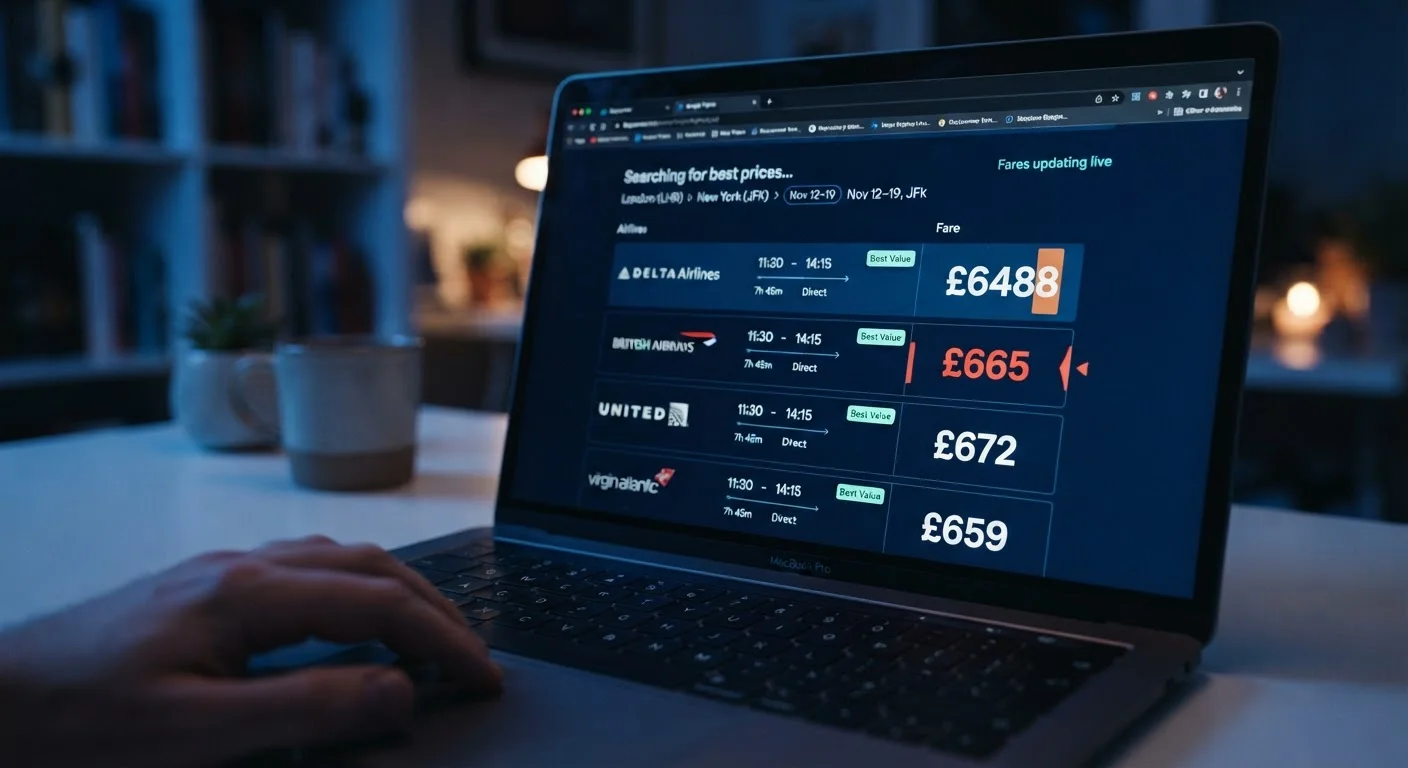
Search engines address this differently. Some show live fares pulled directly from airline APIs; others display aggregated or cached data that may be minutes or even hours old. That discrepancy is why the airline's own checkout page is the definitive price source - not the number shown in the aggregator's results list. For a side-by-side look at how different search tools handle this, see how flight search engines differ.
Separately, many common beliefs about why prices change - like incognito mode preventing price increases, or airlines targeting repeat searchers - don't hold up to scrutiny. Flight pricing myths are worth reviewing before you change your search behavior based on them.
“Airline pricing is not arbitrary - it is a highly disciplined optimization process. Every price you see reflects a calculation about what the market will bear at that specific moment, on that specific flight.”
— Airline Revenue Management Industry Overview, Standard framework description from aviation economics literature