
Why Solo Travelers Consider Group Packages
Traveling alone doesn't mean you have to plan alone. Group tour packages - where a single price covers accommodation, transportation, guided activities, and sometimes meals - have long attracted solo travelers for practical reasons that go beyond mere convenience.
The appeal is especially strong for first-time international travelers or those visiting destinations with significant language barriers, complex visa requirements, or infrastructure that makes independent navigation genuinely difficult. A solo traveler heading to, say, a multi-country itinerary through Central Asia or the Balkans faces a very different planning burden than someone visiting Western Europe with a rail pass.
For an honest look at how group travel compares structurally to going fully independent, see our piece on group tours vs. independent travel. But if you've already decided a group format makes sense, the next question is what the solo experience inside one actually looks like - advantages and all.
Logistics are handled end-to-end
Routing, transfers, hotel sourcing, and guide coordination are managed by the operator, removing the most time-intensive solo planning burdens. This is particularly valuable in destinations with limited English-language infrastructure.
Built-in safety net for unfamiliar destinations
Group tours provide a structured support system - a guide, an operator contact, and fellow travelers - that solo independent travelers must create themselves. This can be especially reassuring in regions with complex political or logistical environments.
Social contact without requiring self-organization
Solo travelers gain access to a ready-made social environment without the effort of independently finding travel companions. Shared experiences on tour naturally accelerate connection in ways that hostel common rooms or apps often don't.
Access to sites difficult to reach independently
Many group tours include private access, guided entry, or reserved time slots at high-demand sites that are genuinely harder to arrange alone. Permits, local fixers, and operator relationships open doors that individual booking cannot always replicate.
Predictable budgeting within the package
A well-specified group package consolidates the largest travel costs into one upfront figure, making total-trip budgeting more predictable than piecing together independent accommodation, transport, and activities.
The Real Costs: Single Supplements and Hidden Fees
The most significant financial drawback for solo travelers in group packages is the single supplement - a surcharge applied when a traveler occupies a double room alone. Tour operators price accommodations assuming two people per room; when that assumption breaks, they pass the cost difference (and sometimes a margin on top) to the solo traveler.
Single supplements vary widely. On budget-oriented small-group tours, the surcharge might be 15-30% above the per-person double rate. On premium or luxury packages, it can reach 100% - effectively doubling your accommodation cost. Some operators offer a room-share matching program, pairing solo travelers with same-gender roommates to waive the supplement, though this introduces its own social variables.
25-100%
Typical single supplement range above base rate
Industry pricing structures for group tours consistently apply this surcharge when solo travelers occupy double-occupancy rooms alone, varying by operator tier and destination.
~16 people
Average small-group tour size
Tours marketed as 'small-group' typically cap at 12-16 participants, a threshold at which solo traveler integration and itinerary flexibility tend to improve noticeably.
Beyond the supplement, solo travelers should scrutinize what's genuinely included. Optional excursions, solo entrance fees at free-exploration sites, solo dining during unstructured meal times, and single-occupancy upgrades on transportation can accumulate quickly. For a broader look at how these costs intersect with solo cruising, see single supplement costs in solo cruising.
Single supplement can significantly inflate total cost
Solo travelers are routinely charged 25-100% above the per-person double rate to occupy a room alone. On longer or premium tours, this surcharge can represent hundreds or even thousands of additional dollars.
Fixed itinerary limits spontaneity and personal pace
Group schedules are built around the needs of all participants, not the individual. A solo traveler who wants to linger at a museum, skip an optional dinner, or adjust their daily rhythm will find those choices constrained by the group's timeline.
Group demographic mismatch can isolate rather than connect
If the group skews heavily toward couples, families, or a significantly different age range, solo travelers may find themselves socially peripheral despite being physically surrounded by people.
Less control over accommodation quality and location
Hotel selections in group packages are made for operational convenience and negotiated group rates, which may not align with the solo traveler's preferences for neighborhood, style, or amenity level.
Optional add-ons erode the all-in price advantage
Free time, optional excursions, and unstructured meals - not included in base pricing - can add meaningful cost, particularly for solo travelers who lack a companion to share expenses during these gaps.
Social Dynamics: The Double-Edged Reality
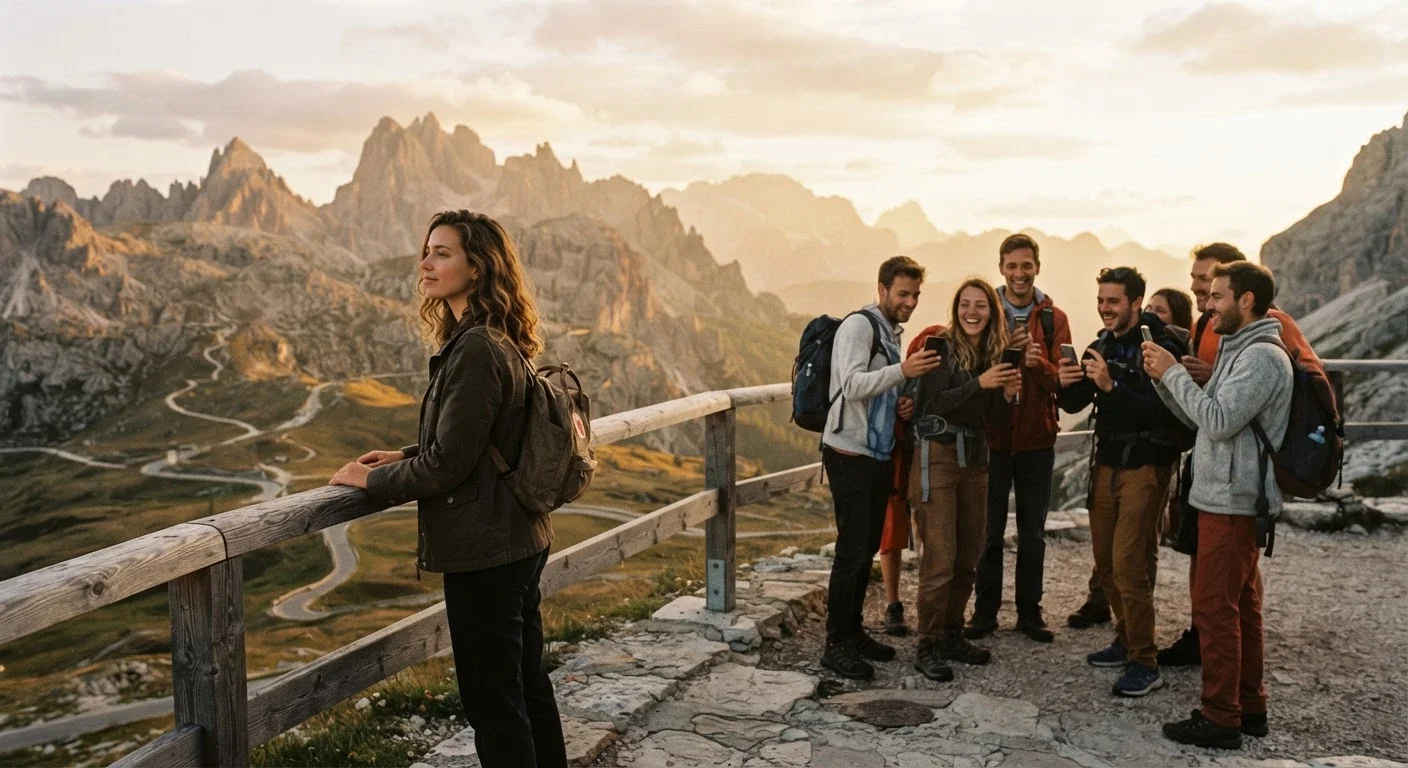
One of the least discussed aspects of solo group travel is social fit. When it works, a group tour delivers something genuinely difficult to manufacture independently: instant community. Shared meals, long coach rides, and navigating unfamiliar places together create the conditions for meaningful connection. Many solo travelers report that group tours led to lasting friendships - an outcome that's hard to replicate when traveling alone.
When it doesn't work, the experience can feel isolating in a paradoxical way. Being surrounded by couples, families, or pre-formed friend groups who naturally pair off during free time can leave a solo traveler feeling conspicuously alone. Group demographics matter more than most brochures acknowledge. A tour marketed broadly to adults may in practice draw mostly retirees or predominantly couples - a context that shapes every meal seating, room pairing, and evening social.
Ask About Group Demographics Before Booking
Tour operators are generally willing to share the typical age range and traveler profile for a given departure if asked directly. Recent traveler reviews on independent platforms can also reveal whether a tour tends to attract couples, families, or mixed solo travelers. This one pre-booking step can make the difference between a tour that feels socially natural and one that feels isolating. See common tour package mistakes for other pre-booking oversights that routinely catch solo travelers off guard.
Group size also affects how visible and integrated a solo traveler feels. Small-group versus large-group tours differ significantly in this respect - a 10-person tour tends to integrate solo members more naturally than a 40-seat coach. Researching typical group demographics before booking - by reading recent traveler reviews, not just marketing copy - is one of the most useful pre-booking steps a solo traveler can take.
For a wider view of the independence trade-offs inherent to any solo journey, the real trade-offs of traveling solo is worth reading alongside this assessment. And for structured planning resources, the solo trip planning hub covers itinerary-building from the ground up.