
Why Lodging Decisions Hit Differently When You're Traveling Solo
When you're traveling with others, accommodation costs split naturally. Solo, you absorb the full nightly rate - which means lodging is usually the largest single expense in your budget. That math makes the choice of where to sleep one of the most consequential decisions in your whole trip plan.
Before diving into options, it helps to be honest about what you actually need. Are you someone who recharges with alone time, or do you want to meet people on the road? How much does light sleep bother you? Do you need a desk, reliable Wi-Fi, or just a place to crash? Your answers will filter the list quickly. If you haven't mapped out your broader trip logistics yet, the complete beginner's guide to solo travel planning is worth reading first.
Dorm bed
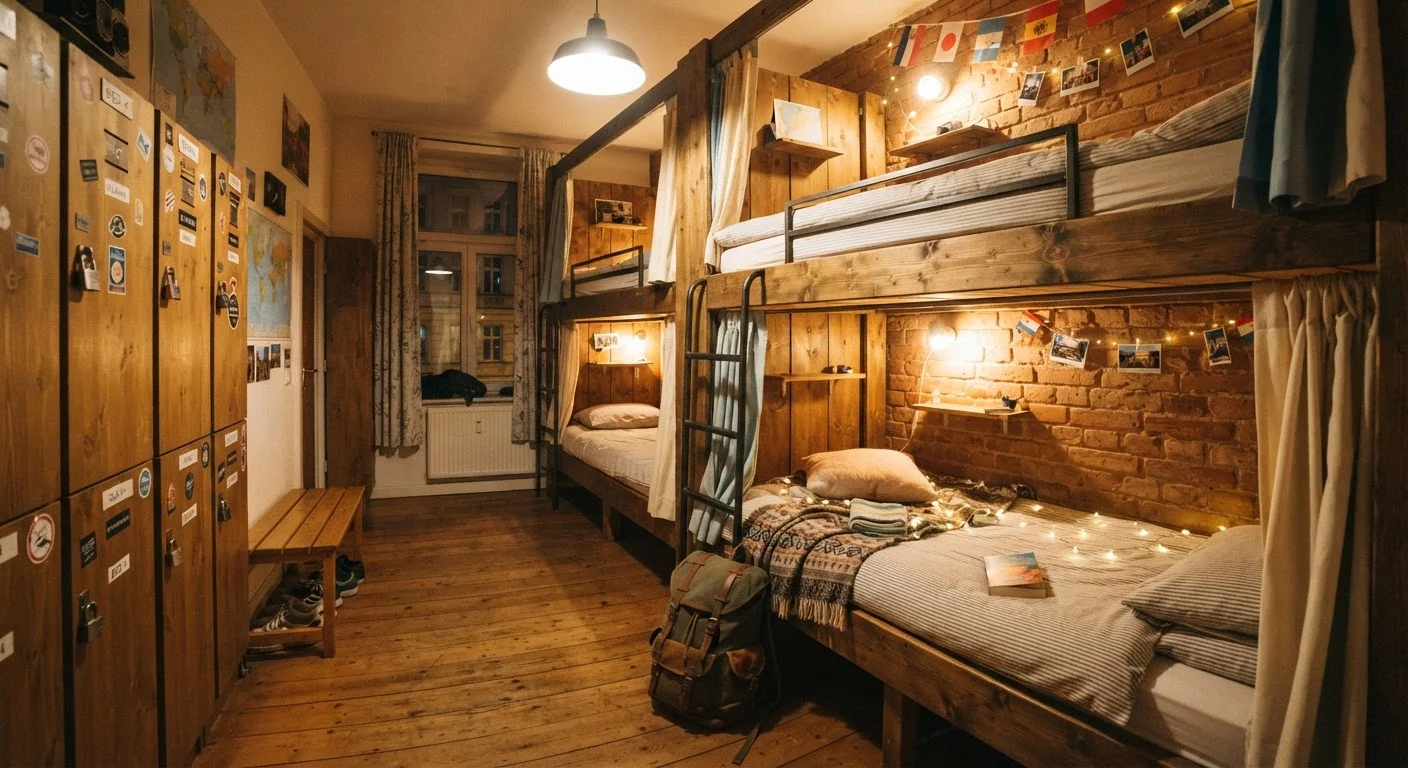
A single sleeping berth in a shared dormitory room, typically in a hostel. You share the space with other travelers, each with their own bed and usually a locker.
Single-occupancy rate
The price a property charges for one person occupying a room designed for more. Hotels often charge close to the double-room rate for a solo guest, which is the core reason lodging costs more per person when traveling alone.
Home-share rental
A lodging arrangement where you rent a private room (or sometimes an entire property) from a local resident through an online platform. Standards, prices, and cancellation terms vary by host.
Capsule hotel
A lodging format, originating in Japan, where guests sleep in individual pod-like compartments rather than traditional rooms. Compact but private within the pod, with shared bathrooms and common areas.
Guesthouse
A small, usually family-run accommodation offering private rooms and basic amenities at prices below standard hotels. Common in many regions worldwide, they often provide a more personal experience than chain properties.
Your Budget Lodging Options at a Glance
Here's a plain rundown of the main categories available to solo travelers working with a tight budget:
- Hostel dorm beds - The floor price of travel lodging in most popular destinations. You share a room with anywhere from 4 to 20 other travelers in bunk beds, with shared bathrooms. Communal kitchens, common rooms, and organized events make these genuinely social environments.
- Private hostel rooms - Your own room within a hostel, at a higher price than a dorm but often lower than a hotel. You still access shared facilities and the communal atmosphere.
- Guesthouses - Small, often family-run properties offering private rooms. Pricing sits between hostels and mid-range hotels. Common in Europe, Southeast Asia, and Latin America, they tend to feel more personal than chains.
- Budget hotels - Privately rated 2- or 3-star hotels where the solo surcharge (single-occupancy rate) is lower than at upscale properties. Amenities vary widely, so reviews matter here.
- Home-share room rentals - Renting a private room in a local resident's home through a home-sharing platform. Often matches hostel pricing, with more privacy and sometimes a more authentic neighborhood experience.
- Capsule hotels - Popular in Japan and increasingly elsewhere, capsule hotels offer individual sleeping pods at low nightly rates. They're compact, private in their way, and surprisingly well-suited to solo travelers.
For a deeper comparison of these types across safety, cost, and social value, see our guide on choosing accommodation that won't drain your solo budget.
Use Reviews Filtered to Solo Travelers
Many booking platforms let you filter guest reviews by traveler type. Reading feedback specifically from solo travelers surfaces details - noise levels, locker quality, staff helpfulness, neighborhood walkability at night - that general ratings won't capture. Spend five minutes on this step before confirming any booking.
Comparing Cost, Safety, and Social Fit
No single lodging type wins on every dimension. The table below gives a realistic sense of the trade-offs:
| Type | Relative Cost | Privacy | Social Opportunity | Best For |
|---|---|---|---|---|
| Hostel dorm | Lowest | Minimal | High | Budget maximizers, social travelers |
| Private hostel room | Low-Medium | Good | Medium | Privacy + community balance |
| Guesthouse | Low-Medium | Good | Low-Medium | Authentic, local-feeling stays |
| Budget hotel | Medium | High | Low | Light sleepers, privacy-first |
| Home-share room | Low-Medium | Medium | Low-Medium | Residential experience, local tips |
| Capsule hotel | Low | Medium | Low | Minimalists, short stays |
On safety: every category can be safe or unsafe depending on the specific property. Filtering reviews by solo travelers, checking whether the property has 24-hour reception, and confirming secure storage for valuables will serve you better than relying on lodging type alone as a proxy for security.
Watch for Hidden Fees Before You Commit
The nightly rate shown in search results often excludes city taxes, cleaning charges, and booking fees that are added at checkout. These can add 15-25% or more to your total. Always click through to the final price confirmation before comparing properties, and check the cancellation policy in case your plans change.
How to Choose the Right Option for Your First Trip
Start by setting a realistic nightly lodging budget - a common rule of thumb for budget solo travel is to allocate roughly 30-40% of your daily spend to accommodation. Then factor in location: a low-rate room that requires two bus rides to reach anywhere useful isn't necessarily a bargain. This is especially relevant if you're considering a road trip format - the solo weekend road trip guide covers how lodging location affects overall trip cost in that context.
A practical first-trip approach for most people: book a hostel dorm for the first two or three nights. You'll meet other travelers quickly, get local recommendations, and find your footing - then adjust for subsequent nights based on how you're actually feeling about privacy and sleep. You're not locked into one format for the whole trip.
Finally, check total price - not just the headline nightly rate. City taxes, cleaning fees, and mandatory charges vary significantly. A guesthouse listing at a lower rate than a hostel dorm may cost more once all fees are added. The full solo travel budget guide walks through how to account for these costs at every stage of your trip, and the Budget Solo Travel hub has ongoing tactics for keeping spend down once you're on the road.
This article provides general travel information for educational purposes. Prices, availability, and property conditions change - always verify current details directly with accommodation providers before booking. For safety and entry requirements, consult official government and destination sources.