

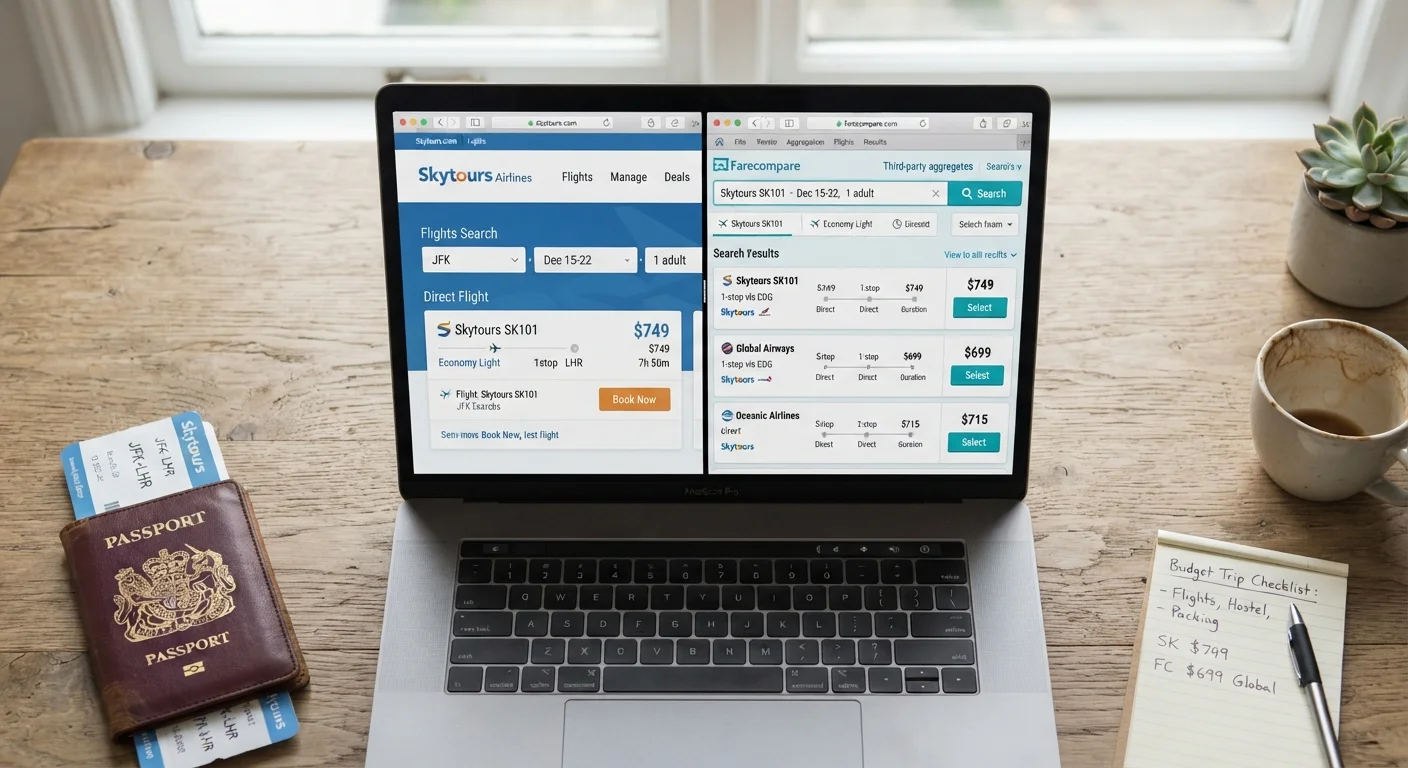
The Core Difference: Who Holds Your Ticket
When you book through an airline's own website or app, your reservation lives entirely within their system. The airline is your contract holder, your support point, and the entity responsible for any changes, cancellations, or rebookings. When you book via a third-party site - an online travel agency (OTA) or aggregator - that platform issues your ticket and sits between you and the carrier.
That distinction sounds administrative, but it has real consequences. During a flight cancellation or significant schedule change, the airline's first obligation is to passengers who booked directly. Third-party ticket holders may need to work through the OTA's support channels, which can add hours of friction during an already stressful disruption. See the full booking strategy guide for how this fits into a broader decision framework.
| Criterion | Booking Direct | Third-Party Site |
|---|---|---|
| Customer support access | Direct with airline | Through OTA intermediary |
| Price comparison | Single airline only | Multiple carriers at once |
| Change/cancel simplicity | Usually faster, self-service | May require OTA coordination |
| Loyalty miles accrual | Typically full credit | Varies; sometimes restricted |
| Ancillary fee transparency | Shown early in flow | Can appear late at checkout |
| Exclusive fares | Sometimes (member pricing) | Aggregated market rates |
| Rebooking during disruption | Airline handles directly | OTA must coordinate first |
Price, Fees, and What You're Actually Comparing
A lower headline price on a third-party site doesn't always translate to a lower total cost. OTAs sometimes add service fees at checkout, and they may not display all ancillary charges - checked baggage, seat selection, itinerary change fees - until late in the booking flow. Always run the numbers to the final payment screen before assuming you've found the better deal.
On the other hand, third-party aggregators do one thing extremely well: they pull fares from multiple carriers simultaneously, which is useful when you're still deciding between routes or airlines. Once you've identified a competitive fare that way, verify it using a structured checklist before committing. Direct airline sites occasionally offer web-only fares or loyalty member pricing not visible on aggregators.
~40%
Travelers who use OTAs for initial fare research
Industry surveys consistently show a large share of flyers use comparison sites to browse before booking, though many finalize purchases elsewhere.
Up to $50+
Potential OTA service fees per ticket
Service fees on third-party platforms vary widely by site and fare class; always check the full checkout total before comparing prices.
Change and Cancellation: Where the Gap Is Largest
This is where the direct-vs.-OTA decision carries the most financial weight. Airlines have automated much of their self-service - fare changes, cancellations, and credits often process in real time through their own apps. When your ticket is held by a third party, that same change often requires the OTA to contact the airline on your behalf, which can mean wait times, manual processing, and occasionally conflicting information about what's permitted.
Some OTAs offer their own cancellation protection products, but these vary widely in scope and reliability. Read the terms carefully - particularly what counts as a qualifying reason for a refund. If you're booking a route with any schedule uncertainty, the added simplicity of a direct booking is often worth it. This is especially relevant if you're already navigating the risks of split-ticket itineraries, where disruptions on one leg can strand you on another.
OTA Protections Vary Significantly
Not all online travel agencies operate the same way. Some offer 24-hour cancellation windows, while others process refunds through the airline directly. Before booking through any third-party platform, review their specific change and cancellation policies - particularly for non-refundable fares. If a fee dispute arises, resolution timelines can differ substantially from what the airline itself would offer.
Practical Advice: How to Use Both Intelligently
A sensible approach for many travelers is to use third-party sites as a research and comparison tool, then book directly with the airline once you've identified the right flight. This gives you the search breadth of an aggregator without surrendering the direct-booking protections that matter when plans change.
Before you even open a search tool, it's worth confirming your travel dates, passport validity, and baggage requirements - the pre-booking checklist covers exactly this. Once you're ready to book, the practical walkthrough from search to confirmation can guide you through the full process. Neither booking method is inherently better - the right call depends on your itinerary complexity, flexibility needs, and how much customer service access matters to you. Make that judgment deliberately, not by default.