
What Makes a Country a True Budget Destination?
Calling a place "affordable" without context is nearly meaningless. For American travelers, a genuine budget destination combines low day-to-day costs with visa ease, enough infrastructure to travel comfortably, and experiences that feel substantive - not diminished by the price tag. On all of these measures, the Republic of Georgia delivers in ways that still surprise most Western travelers who haven't considered it.
Compare Georgia to the usual shortlist of low-cost international travel. Southeast Asia remains a benchmark for value, and Eastern Europe offers strong dollar performance across several nations. Georgia competes directly with both regions in cost terms - but with a cultural depth and landscape variety that few travelers anticipate.
365 days
Visa-free stay for U.S. passport holders
Georgia grants American citizens one of the world's most generous visa-free access periods, requiring no application or fee.
$30-$60
Estimated daily budget for comfortable travel
Reported by independent travelers covering guesthouse accommodation, local meals, and public or shared transportation.
~8,000 years
Age of Georgia's winemaking tradition
Archaeological evidence places the origins of Georgian viticulture among the earliest in the world, recognized by UNESCO.
~26,900 sq mi
Total area - roughly the size of West Virginia
Georgia's compact geography means diverse landscapes and landmarks are accessible within relatively short travel distances.
The Real Cost of Traveling Georgia
Budget travelers report daily costs of $30-$60 covering a guesthouse or budget hotel, three meals, and local transit. That's not a survival budget - Georgian hospitality is generous by nature, and that figure includes eating well. A traditional spread of khinkali (dumplings), khachapuri (cheese-filled bread), and grilled meats at a local restaurant typically runs $5-$10 per person. Wine, Georgia's ancient cultural export, is inexpensive even at sit-down restaurants.
Accommodation options range from family-run guesthouses in mountain villages - often including breakfast and dinner in the room rate - to stylish boutique hotels in Tbilisi for under $50 per night. Transportation between cities by marshrutka (shared minibus) costs a few dollars per journey. Car rental is available for reaching remote monasteries and mountain roads, though roads vary significantly in condition outside major corridors.
Book Guesthouses Directly When Possible
In rural Georgia and mountain villages, many family-run guesthouses aren't listed on major booking platforms. Arriving in a village and asking locally - or using regional travel forums - can yield better rates and more authentic stays. Some guesthouses include homemade meals in their rates, which significantly improves overall value.
Visa-Free Entry: A Rare and Practical Advantage
For Americans accustomed to navigating visa applications, Georgia's policy is unusually straightforward: U.S. passport holders can enter and remain for up to 365 days without a visa. This makes Georgia one of the few countries in the world offering this level of access to American citizens.
In practical terms, this means Georgia works equally well as a two-week vacation, a month-long slow travel base, or an extended working-abroad option for those with location flexibility. There are no visa fees to factor into the travel budget, no applications to prepare in advance, and no embassy appointments required. As always, entry policies can change - confirm current requirements through the U.S. Department of State at travel.state.gov before booking.
What Georgia Offers Beyond the Price Tag
The value argument for Georgia would be incomplete without addressing what that money actually buys. The country contains an extraordinary concentration of landmarks within a small geographic area (roughly the size of West Virginia).
- Tbilisi: A capital city with a layered old town, sulfuric bathhouses, art nouveau architecture, and one of Europe's most dynamic food and nightlife scenes.
- Kazbegi and the Greater Caucasus: Mountain terrain rivaling the Alps, with the Gergeti Trinity Church perched above the clouds as an iconic reference point.
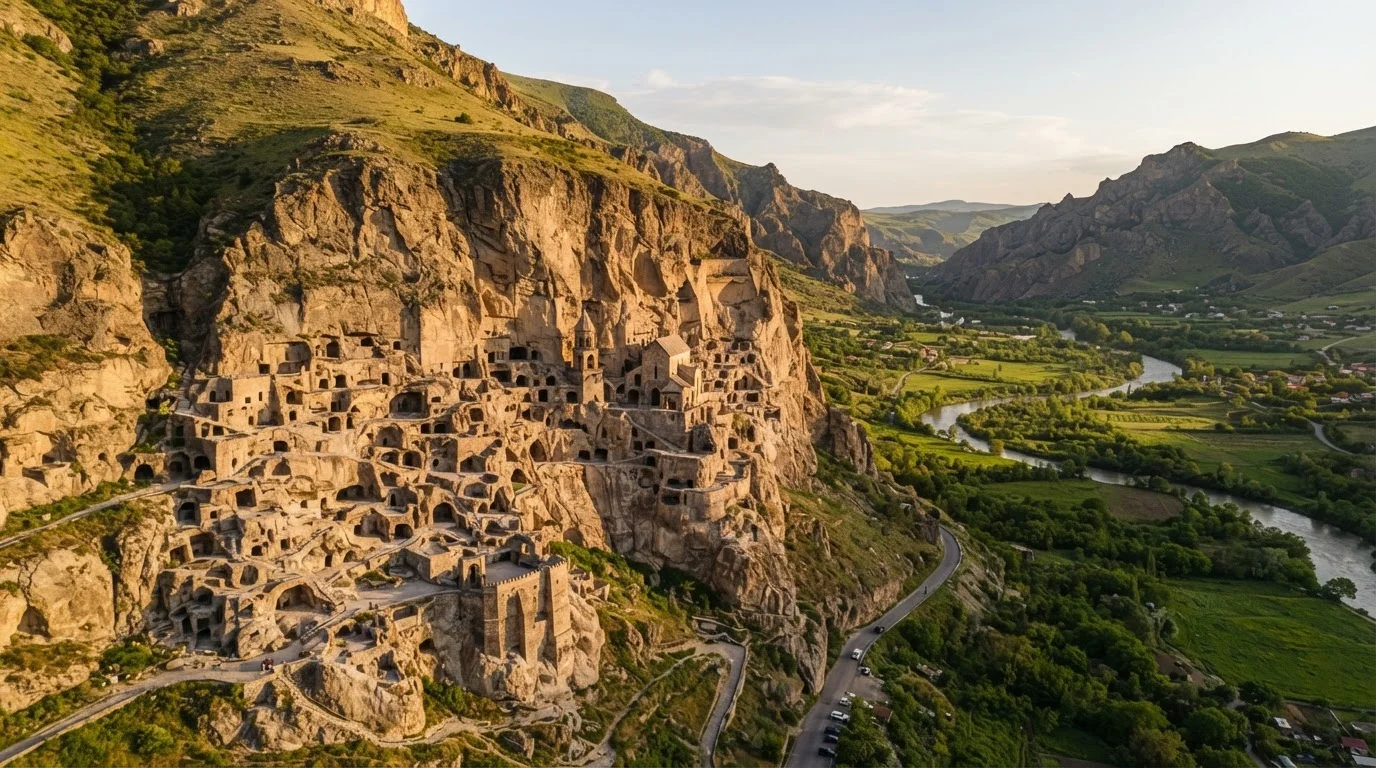
- Vardzia: A 12th-century cave monastery complex carved into a volcanic cliff face - one of the most dramatic archaeological sites in the Caucasus region.
- Kakheti wine region: The cradle of the world's oldest winemaking tradition, with amber wines fermented in clay vessels called qvevri, recognized by UNESCO.
This variety is accessible across relatively short distances, making Georgia well-suited to travelers who want to cover significant ground in a limited time.
Getting There and Fitting Georgia Into a Broader Itinerary
No nonstop flights connect U.S. cities to Tbilisi's Shota Rustaveli International Airport. Most travelers connect through Istanbul - a hub particularly well-served from major American cities - or through European gateways such as Frankfurt, Vienna, or Amsterdam. Total travel time with one layover typically ranges from 14 to 20 hours. Understanding what drives airfare pricing to budget destinations can help travelers time their searches effectively.
Georgia's location also makes it a natural pairing destination. Istanbul, Yerevan (Armenia), and Baku (Azerbaijan) are all within striking distance, supporting multi-country Caucasus itineraries. For travelers weighing regions, Africa's most budget-friendly destinations offer a different but comparably compelling value case depending on interests and routing.
It's worth noting that Georgia's appeal is distinct from domestic alternatives. While underrated U.S. destinations can deliver strong value, international travel to Georgia introduces a fundamentally different cultural and culinary experience at costs that are difficult to match inside the U.S.
Travel conditions, entry requirements, and safety situations can change. Always verify current information with the U.S. Department of State and relevant official sources before making travel arrangements.