
Why Sedona Is Worth Skipping (At Least This Time)
Sedona is genuinely beautiful - nobody's disputing that. But it's also one of the most visited spots in the Southwest, and prices across lodging, tours, and dining have climbed accordingly. Parking fills by 8 a.m. on weekends, shuttle reservations sell out, and the iconic red rock views now come with significant competition for elbow room.
The good news: the Desert Southwest is enormous, and the geology doesn't stop at Sedona's city limits. Vast stretches of New Mexico, Utah, and Arizona serve up equally jaw-dropping formations - alien-looking hoodoos, ancient petroglyphs, slot canyons, and sky island forests - with a fraction of the foot traffic and, often, zero entry fees. As we've explored in our piece on lesser-known public lands worth the drive, BLM land and national monuments regularly rival famous parks in raw scenery. Below, five destinations that prove it.
Bisti/De-Na-Zin Wilderness, New Mexico
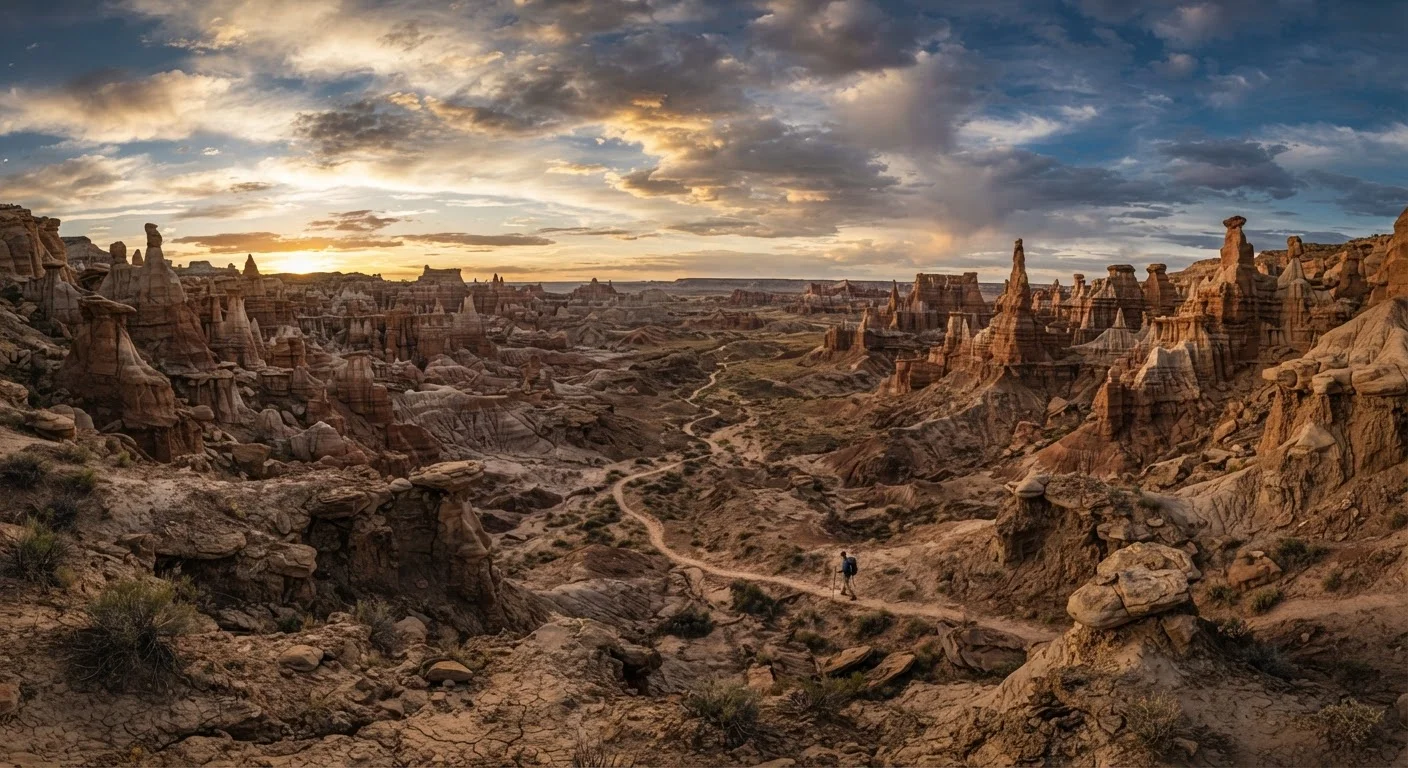
Few landscapes in the US look less like Earth than the Bisti Badlands in northwestern New Mexico. Eroded shale and mudstone have produced a field of hoodoos, cracked clay pans, and petrified wood that hikers routinely describe as walking on another planet. There are no marked trails - you navigate by compass, landmark, or downloaded GPS track - which keeps casual visitors away and rewards those who come prepared.
Entry is free, managed by the Bureau of Land Management, and no permit is currently required for day use. The nearest sizable town is Farmington, roughly 40 miles north, where lodging remains far more affordable than any Sedona-area property. Plan for a full day; the terrain is disorienting in the best possible way.
No trails, no fees, no crowds - Bisti is the Desert Southwest at its most raw.
San Rafael Swell, Utah
Wedged between Price and Green River in central Utah, the San Rafael Swell is a massive geological upheaval - a dome of sandstone cracked open by erosion into canyons, mesas, and a tangle of slot canyons that would headline any national park. It doesn't have that designation, which is exactly why you should go.
Dispersed camping on BLM land throughout the Swell is free with standard Leave No Trace rules. The Wedge Overlook, sometimes called Utah's Little Grand Canyon, requires no fee and little more than a short walk. Goblin Valley State Park sits at the Swell's edge and does charge a day-use fee, but it's one of the more unusual landscapes in the entire state. Budget travelers combining the Swell with the broader Utah parks circuit will find it slots easily into a road trip route without adding meaningful cost.
The San Rafael Swell packs national-park drama into a free, crowd-light BLM landscape.
Chiricahua National Monument, Arizona
Southeast Arizona's Chiricahua Mountains are a sky island - a forested mountain range rising abruptly from desert grassland, creating a distinct ecological zone that supports wildlife and plant species found nowhere else nearby. The national monument at their heart protects an extraordinary field of rhyolite columns and balanced rocks, the result of a volcanic eruption roughly 27 million years ago.
A standard National Park Service fee applies, and the America the Beautiful pass covers it. Visitor numbers are a sliver of southern Arizona's more famous sites. The nearby town of Willcox offers genuinely affordable motels and has become a low-key destination for birders and wine-curious travelers, which keeps its infrastructure practical rather than boutique-priced.
Chiricahua's volcanic rock columns rival anything in the Southwest - at a fraction of the crowds.
Ghost Ranch Area, New Mexico
Most visitors to northern New Mexico head straight for Santa Fe or Taos. The Ghost Ranch corridor along US-84 in the Chama River valley offers something quieter: the same sculpted mesa-and-canyon landscape that defined Georgia O'Keeffe's paintings, accessible via short trails on both BLM land and the Ghost Ranch education and retreat center (which manages its own trails with a modest day-use donation).
Abiquiú Lake, managed by the Army Corps of Engineers, provides low-cost camping with red-cliff views. This stretch of New Mexico rewards slow, unhurried driving more than rapid sightseeing - exactly the mindset that keeps a trip affordable. It's the kind of locale that fits neatly into the case we made in domestic travel doesn't mean boring.
Ghost Ranch's mesa country delivers world-class scenery on a slow-drive, low-spend itinerary.
Vermilion Cliffs National Monument, Arizona/Utah Border
The Vermilion Cliffs sit just north of the Grand Canyon's North Rim, but they operate on an almost entirely different visitor scale. The monument encompasses the Paria Canyon-Vermilion Cliffs Wilderness, including the famous Wave formation (which requires a lottery permit) and dozens of less-contested hikes through slot canyons and across open slickrock.
Beyond the Wave, trails like the White Pocket area are accessible without permits - though the road requires a high-clearance 4WD vehicle, which is worth confirming before you go. The town of Kanab, Utah, just to the north, has evolved into a practical, moderately priced hub for this corner of the Colorado Plateau. It's a natural complement to anyone building a broader Desert Southwest road trip that doesn't depend on Zion or the Grand Canyon's most crowded corridors.
Vermilion Cliffs rewards permit-holders and spontaneous explorers alike - often on the same trail.
Plan Smart, Spend Less
These five destinations share a few key traits that make them genuinely budget-friendly rather than just romantically remote. Most involve free or low-cost entry on BLM or Forest Service land, modest gateway towns with practical lodging options, and road conditions that reward a well-maintained passenger car (though always check current road conditions before heading out - seasonal closures and flash floods can affect access).
Download offline maps before you go
Cell coverage is sparse or nonexistent across most of these destinations. Apps like Gaia GPS or Avenza Maps let you download topographic layers for offline use before you leave town. This is especially critical at Bisti, where there are no marked trails, and at the San Rafael Swell, where many trailheads aren't labeled on standard navigation apps.
If you're stringing several of these stops together, they pair naturally with a broader Southwest road trip - our Southwest desert loop route guide covers pass strategy and free camping logistics in detail. And if you'd rather anchor a trip around a walkable town instead of pure wilderness, small cities worth a weekend rounds up the region's most rewarding smaller urban stops. Either way, the Desert Southwest rewards curiosity far more than it rewards a packed itinerary.
Road conditions, camping availability, and access rules change seasonally. Always verify current conditions with the managing agency - BLM, National Park Service, or the relevant Forest Service district - before your trip.