

Why Booking Strategy Matters More Than Luck
Flight prices are set by dynamic pricing algorithms that adjust fares hundreds of times a day based on demand, remaining seat inventory, competitor pricing, and seasonality. That volatility is exactly why a structured approach beats checking prices at random and hoping for the best.
Research consistently shows that travelers who search with a plan - defined date ranges, a clear sense of acceptable airports, and an understanding of when prices typically move - tend to pay less than those who search impulsively. The goal here isn't to game an opaque system but to understand its patterns well enough to work with them. For a grounding in the broader landscape of finding affordable airfares, that context is worth having before diving into tactics.
No Tool Predicts Prices Reliably
Fare prediction features - 'prices are likely to rise' or 'wait to book' indicators - are directional signals based on historical patterns, not guarantees. Airline pricing algorithms respond to real-time demand in ways that historical data cannot fully anticipate. Use these signals as one input, not as a decision-maker, and accept that uncertainty is an inherent part of airfare pricing.
The Booking Window: When to Search and When to Buy
Booking window - the span of time between purchase and departure - is one of the most studied variables in airfare pricing. Analysis of domestic U.S. routes has repeatedly found that fares are often most competitive in the window of roughly one to three months before departure. International routes generally reward earlier purchases, with three to six months out being a reasonable target for many long-haul itineraries.
That said, averages mask significant variation by route, season, and carrier. A thin-market route with limited competition may be expensive at any booking window. High-demand travel periods - major holidays, spring break, summer peak - compress the window: prices rise earlier and rarely fall late.
1-3 months
Optimal domestic booking window
Multiple fare analysis studies suggest domestic U.S. fares are often most stable and competitive when purchased one to three months before departure.
3-6 months
Common international booking lead time
Industry analysis of transatlantic and transpacific routes generally points to three to six months out as a reasonable target for long-haul travel.
24 hours
Free cancellation window (U.S. DOT rule)
U.S. Department of Transportation rules generally require airlines to allow free cancellation within 24 hours of booking on tickets purchased at least seven days before departure.
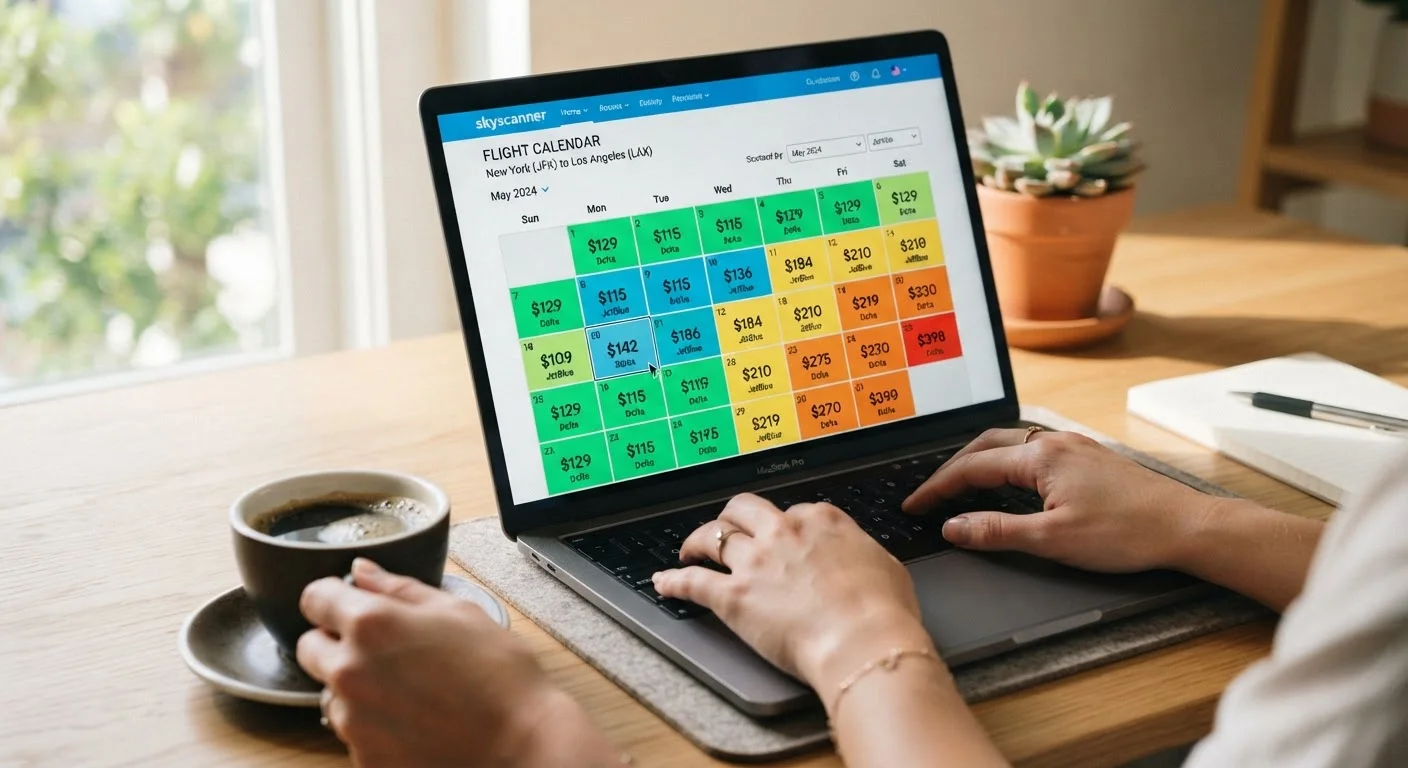
Before committing to any date, run a flexible date search (most major aggregators offer a calendar or grid view). Shifting departure by one or two days can produce fare differences of 20-40% on some routes, with midweek departures tending to be less expensive on many domestic routes. For a closer look at which popular timing beliefs actually hold up, see which booking timing myths have evidence behind them.
Building Your Search Toolkit
Effective searching starts with using the right combination of tools rather than relying on a single platform. Flight aggregators compile fares across multiple carriers and let you compare apples to apples. Airline direct websites sometimes surface fares that aggregators miss, particularly for basic economy or promotional pricing. Setting up fare alerts - automated notifications that trigger when a route drops to a target price - removes the need to check manually and reduces the temptation to buy impulsively when a price looks low but isn't.
Search a destination first, then lock in dates - not the other way around. Seeing the full price calendar before committing to specific days often surfaces savings that a fixed-date search never would.
Flexible date tools reveal the fare distribution across a month; most travelers who fix dates first never see how much cheaper adjacent days can be.
Set fare alerts for every route you're seriously considering, even if you're not ready to book. Alerts let you track a route's natural price range before you need to make a decision.
Knowing a route's recent price range gives you a meaningful baseline, so you can recognize a genuinely low fare rather than one that just feels low in the moment.
Google Flights' price graph and Explore features are useful for visualizing fare ranges across a month or across multiple destinations simultaneously. Kayak's price trend indicator gives a directional signal (though no tool predicts prices with certainty). For a structured walkthrough of how to move from search to an actual booking decision, the practical booking walkthrough covers each stage in detail.
Use Multiple Search Surfaces in Parallel
Run the same search on at least two aggregators and then check the airline's direct site. Fare availability and pricing can differ across platforms, and a two-minute cross-check has a measurable chance of surfacing a lower total. Don't rely on any single source as exhaustive.
Reading Prices and Spotting Inflated Fares
A fare that looks low on a search results page can look very different at checkout. Basic economy fares on many carriers strip out seat selection, carry-on baggage, and change flexibility - costs that add up quickly. Before treating a price as real, mentally add: checked bag fee (if applicable), carry-on fee (on ultra-low-cost carriers), and seat assignment fee if you need a specific seat.
Comparing apples to apples means holding fare class constant. A $199 basic economy fare versus a $249 standard economy fare may favor the latter once a $35 carry-on fee is added to the former. The complete guide to finding cheap flights goes deeper on fare class mechanics and how to evaluate total cost accurately.
Watch for Fees That Change the Real Price
Ultra-low-cost carriers in particular price base fares attractively but charge for items most travelers consider standard - carry-on bags, seat selection, and even printing a boarding pass at the airport. Always calculate the all-in cost before comparing fares across carriers. A fare that looks 30% cheaper can easily become more expensive once ancillary fees are added.
Price history tools - available in some browser extensions and aggregators - show what a route has sold for over recent weeks. Use this to calibrate whether the current price is above or below the recent range, not as a prediction of where prices will go next.
From Search to Confirmed Ticket: The Final Steps
Once you've identified a fare that clears your total-cost check, act within a reasonable window but not under artificial pressure. Most domestic fares hold for at least a few hours; many aggregators now offer a 24-hour hold option, and U.S. Department of Transportation rules generally require airlines to allow free cancellation within 24 hours of booking on tickets purchased at least seven days before departure - verify current rules with your airline directly.
Before confirming, double-check: passenger name matches government ID exactly, departure airport (not just city - some metro areas have multiple airports), connection times are realistic (under 60 minutes for domestic connections can be risky), and the routing doesn't create issues if one segment is delayed. For situations where your flight may be oversold, understanding how voluntary bumping works can turn a disruption into a decision you're prepared for.
After booking, save your confirmation number and the airline's direct customer service contact - not just the booking platform's. If anything changes, you'll want to reach the operating carrier directly. Screenshot your fare rules, especially refund and change conditions, at the time of booking.
“The best time to buy an airline ticket is when you find a price you're comfortable with and that meets your budget - trying to time the perfect moment usually costs more in stress than it saves in dollars.”
— George Hobica, Founder of Airfarewatchdog, frequently cited airfare analyst
Prices, availability, and airline policies change frequently. Always verify current fare rules, bag fees, and entry requirements with the airline and relevant government sources before completing any booking.