
Why Daily Cost Management Matters More Than Your Total Trip Budget
Most travelers set a total trip budget, then spend it unevenly - blowing past it in the first few days and scrambling to compensate later. The fix isn't a bigger budget; it's shifting focus from the total to the daily rate. When you know how much you can spend today, every purchase has a clear reference point.
Total budgets obscure the mechanics of where money actually goes. A $3,000 budget for ten days means $300 per day - but that number is meaningless unless it's broken into food, transport, accommodation, activities, and incidentals. Without that structure, small daily overruns compound silently until they become a real problem.
Daily cost management also gives you permission to spend strategically. If you underspend on transit Monday, you can justify a nicer meal Tuesday. That flexibility is only possible when you're tracking at the day level.
~42%
Travelers who exceed their trip budget
Survey data from various travel finance studies consistently show roughly four in ten travelers spend more than planned, most commonly due to untracked daily expenses.
10-15%
Recommended daily budget buffer
Travel finance practitioners generally advise adding a 10-15% buffer to daily cost estimates to absorb currency shifts and unanticipated expenses.
5 min
Daily expense review time needed
A brief nightly tally - under five minutes - is widely cited by budget travelers as the single habit most effective at preventing compounding overruns.
Building Your Daily Budget Before You Leave
Pre-trip research is where your framework takes shape. Start with the building blocks of a realistic daily travel budget - food, local transport, accommodation, activities, and a miscellaneous category. For each, research realistic costs specific to your destination using traveler forums, destination tourism boards, and published travel guides.
Assign a daily ceiling to each category, not just to the total. Then apply a 10-15% buffer on top of your subtotal. This buffer absorbs currency fluctuation, entry fees you didn't anticipate, or a day when you simply need a taxi instead of a bus.
For a more structured approach, the daily travel budget planner checklist walks through every pre-trip cost category so nothing is missed before you land.
Lock In Your Daily Rate Before Booking Anything
Calculate your per-day ceiling before you book flights or accommodation. Once lodging is booked, that category is fixed - if it's over budget, you have fewer levers to pull later. Starting with a realistic daily number lets every subsequent booking decision be measured against a real constraint.
If you're planning a family trip, daily cost dynamics shift significantly - the complete guide to budget family travel covers how group size affects per-person daily rates and which costs don't scale linearly.
Tracking Spending on the Ground
The most sophisticated pre-trip budget fails if you don't track in real time. The method matters less than the consistency: a notes app, a spreadsheet, a dedicated expense-tracking app, or even a small notebook all work. Choose whichever you'll actually use every day.
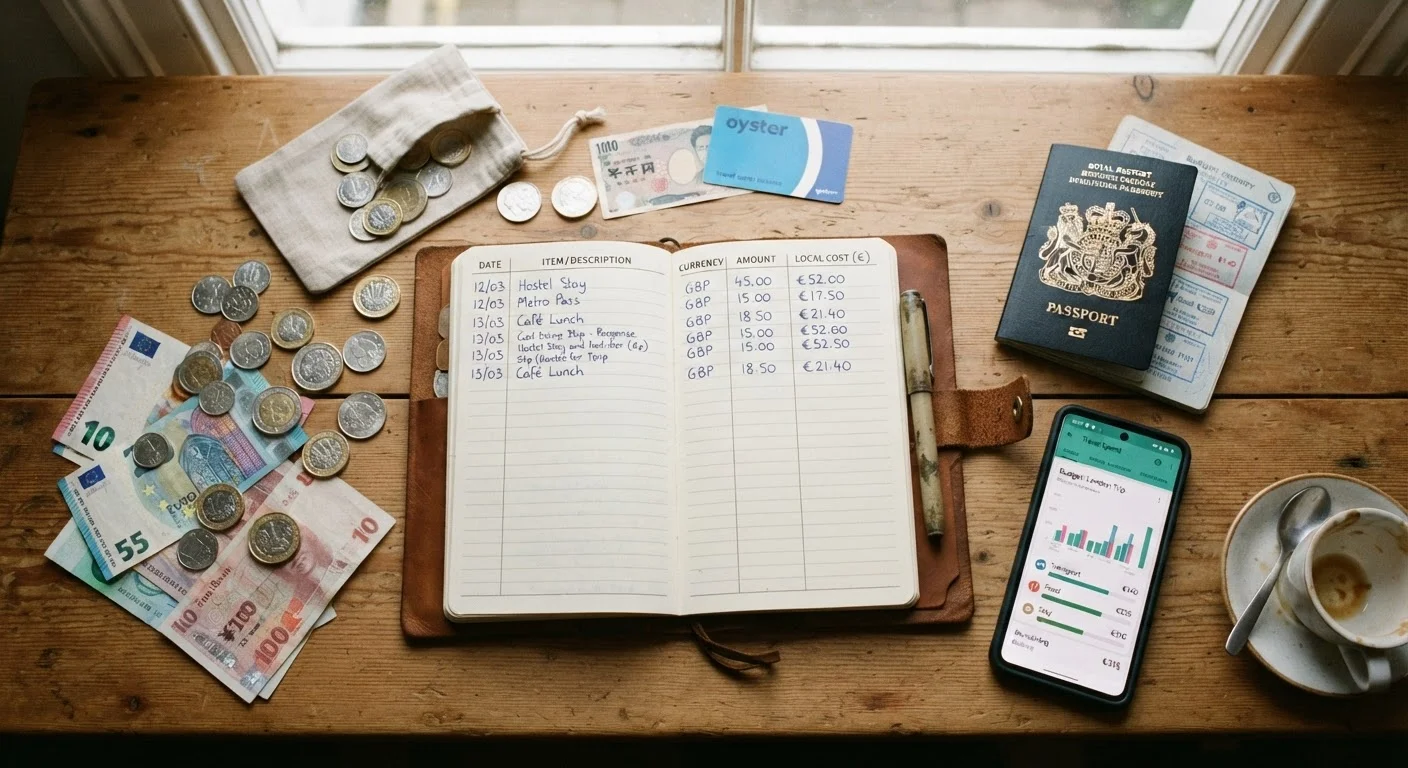
Log every expense at the point of purchase or within the same evening. Waiting until the end of the trip introduces too much guesswork. Group each entry under its category - food, transport, activities - so you can see at a glance which category is running hot.
Set a separate "miscellaneous" daily allocation of at least $10-15 and treat it as untouchable until day's end. This absorbs the small, unplanned purchases - a bottle of water, a transit card top-up - that erode budgets invisibly.
Miscellaneous expenses are the most consistently underestimated category in traveler budgets, and they accumulate fastest precisely because each individual purchase feels too small to log.
At the end of each week, tally your category totals and compare them to your planned allocations. Weekly reviews catch slow-burn overruns that daily checks miss - especially in categories like dining, where habits form quickly.
Daily snapshots show whether you're on target today; weekly rollups reveal structural patterns - like consistently overspending on food - that require a category-level correction rather than a one-day fix.
Do a brief end-of-day review: total your spend, compare it to your daily ceiling, and note any category that exceeded its allocation. This takes under five minutes and prevents compounding overruns. It also builds a dataset you can use to recalibrate future travel budgets.
Adjusting When You Overspend
Overspending on a single day doesn't break a trip - ignoring it does. The moment you notice a daily total above your ceiling, treat it as actionable information rather than a failure.
Overspending Requires a Specific Response Plan
When a day exceeds your ceiling, the worst response is to ignore it and hope the average works out. Calculate the exact shortfall, divide it across remaining days, and identify at least two specific expenses you will reduce. A vague plan to "spend less" almost never closes the gap.
Calculate the shortfall and distribute it across the remaining days. If you overspent by $40 today and have five days left, you need to find $8 in savings per day - not $40 in a single day of deprivation. Practical levers include switching one restaurant meal to a market or grocery alternative, using public transit instead of rideshare for a day, or skipping one paid activity in favor of a free attraction.
Keep a short list of flexible expenses in each category - costs you could reduce without meaningfully harming your experience. Having that list ready before you need it makes in-trip adjustments fast and low-stress.
Managing Costs Across Multiple Destinations
A single daily rate doesn't work for trips that cross countries or regions with very different cost levels. Assign a destination-specific daily ceiling to each leg of your trip. A day in a major Western European capital and a day in a smaller Southeast Asian city carry fundamentally different baseline costs.
Account for transition-day costs separately - travel days typically involve airport meals, transport between cities, and less time to use low-cost alternatives like cooking your own food. Budget these days at a higher daily rate or create a separate "travel day" allocation.
The daily budget best practices for multi-destination trips goes deeper on currency management and cost-level adjustments when your itinerary spans multiple countries. For road-based itineraries in the US, road trip route planning resources can help you model fuel and overnight costs by segment.
Currency Conversion Adds Hidden Cost
On multi-currency trips, daily budget comparisons are only meaningful if you're converting all expenses to a single base currency consistently. Use the same conversion rate throughout each destination leg - mid-market rates are the most neutral benchmark - and adjust only when you move to a new currency. Dynamic conversion at point-of-sale often applies unfavorable rates.
Putting It All Together
An effective daily cost framework has three phases that work together: a category-by-category daily budget built before departure, consistent same-day tracking on the ground, and a systematic response whenever a day runs over. None of these phases is complicated on its own - the value comes from running all three together, consistently, throughout the trip.
Solo travelers have an additional lever: itinerary flexibility. If you're traveling alone, you can shift to a lower-cost destination or extend a cheaper stop when the budget is under pressure. The solo trip planning hub covers how to build that flexibility into your itinerary from the start.
Daily cost management isn't about restricting your travel experience - it's about making sure your money is directed where it matters most to you. With a clear framework in place before you leave, and a habit of checking in daily once you're on the road, your budget becomes a tool for better travel rather than a source of anxiety.
This article provides general travel budgeting information for educational purposes. It does not constitute personalised financial advice. Travel costs vary widely by destination, season, and individual circumstances - verify current prices and entry requirements with official sources before travelling.