

Why 'Budget' Doesn't Mean the Same Thing Twice
Ask ten travelers what a budget weekend trip costs and you'll get ten different answers. That's not evasion - it reflects something genuinely true about travel spending: context matters enormously. A $250 weekend feels lavish to one traveler and spartan to another, depending on where they live, how they travel, and what they're willing to trade off.
In practical terms, most solo US travelers can pull off a solid weekend getaway for somewhere between $150 and $400 per person - and that range widens considerably once you factor in driving distance, accommodation type, and whether you're cooking your own food. Couples traveling together often land closer to the lower end per person thanks to shared lodging costs. For families, the equation shifts again; the real cost of a family vacation reveals just how quickly individual line items multiply.
The more useful framing isn't a single dollar figure - it's understanding where the money goes and which categories offer the most flexibility.
$150-$400
Typical per-person cost for a US weekend getaway
A general range based on typical lodging, transportation, food, and activity costs for solo travelers; couples and families will see different per-person figures.
60-70%
Share of weekend budget spent on lodging and transport
Lodging and getting there consistently dominate short-trip spending, leaving relatively little room for food and activities in a tight budget.
$20-$35
Average campsite cost per night at US state parks
Camping remains one of the most cost-effective overnight options for budget travelers, though rates vary by state and season.
The Spending Breakdown: Where Your Weekend Dollars Actually Land
On a typical two-night US weekend trip, budget allocation tends to look something like this:
- Lodging (35-50%): This is almost always the biggest line item. A budget motel in a mid-size city might run $80-$120 per night; camping can drop that to $20-$35 per site. Splitting a room or booking a vacation rental helps significantly.
- Transportation (20-30%): If you're driving, factor in gas and parking - usually $30-$80 round trip within a few hundred miles. Flying for a weekend is rarely budget-friendly once you include airport transfers and checked bags.
- Food (15-25%): Eating out every meal is the fastest way to blow a weekend budget. A mix of grocery store finds, picnic lunches, and one sit-down dinner gives you the experience without the full restaurant bill.
- Activities (5-15%): This is where US travel genuinely excels at the low end. State parks, historic downtowns, public beaches, and local markets are free or nearly so. See free and low-cost weekend activities for a deep dive by destination type.
Understanding this breakdown is more actionable than chasing a single total number, because it shows you exactly which lever to pull.
Your Most Flexible Budget Line: Food
Accommodation and transport costs are largely set once you've committed to a destination and mode of travel. Food is where you retain the most real-time control. A grocery run on the way in - snacks, sandwich fixings, breakfast items - can save $30-$60 over a weekend without making the trip feel like a sacrifice. Reserve the sit-down meal for a dinner that genuinely adds to the experience.
What 'Shoestring' Looks Like Across Different US Regions
Regional cost variation in the US is substantial and often underestimated. A 'budget' trip to coastal Maine looks very different from one to the Texas Hill Country or the rural Ozarks - not because the experiences are lesser, but because local price floors differ.
Generally speaking, the Southeast and Midwest offer the most stretching power for budget travelers: lower motel rates, cheaper gas relative to distances, and strong public lands access. The Northeast and Pacific Coast tend to have higher accommodation floors, though free outdoor assets - beaches, trails, urban parks - help offset activity costs. The Mountain West sits in between, with free federal land access but rising gateway-town prices in popular spots.
For a region-by-region snapshot of typical drive times and cost ranges, the US weekend getaway quick reference is a handy starting point. And if you've been skeptical about domestic travel being worth the effort, the myth that budget US travel means boring travel makes a compelling case otherwise.
Making the Numbers Work: One Decision That Changes Everything
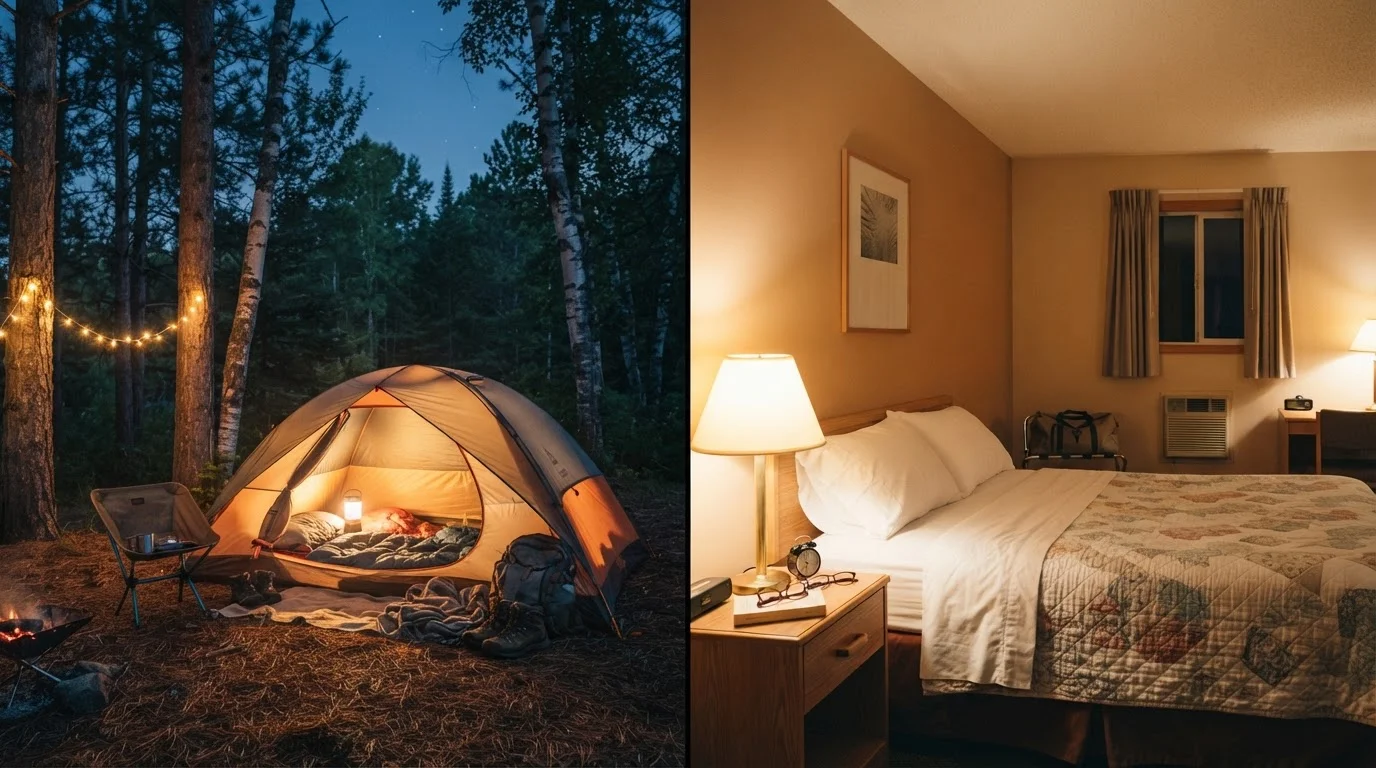
If there's a single variable that most reliably separates a $175 weekend from a $450 weekend, it's your choice of accommodation. Driving past a $150/night property to find a $60 campsite or a $75 hostel dorm doesn't just save $75-$150 per night - it reframes your entire relationship with the trip. Suddenly food and activities have real breathing room.
The tradeoff question is one of comfort versus cost, and it's personal. Our comparison of camping versus budget lodging walks through the practical differences in detail - including scenarios where camping isn't actually cheaper once gear rental is factored in.
The takeaway: a shoestring weekend isn't about deprivation. It's about making deliberate choices in the categories that matter most and letting yourself enjoy the trip you planned - without the bill shock on Monday morning.
“The best trips aren't the ones where you spent the most - they're the ones where you made the most of what you had. Every constraint in travel forces a kind of creativity that often produces the most memorable moments.”
— Arthur Frommer, Travel writer and author of 'Europe on 5 Dollars a Day'
Prices, availability, and conditions at any destination can change. Always verify current rates and entry requirements directly with providers and, for anything safety-related, consult official sources before you travel.