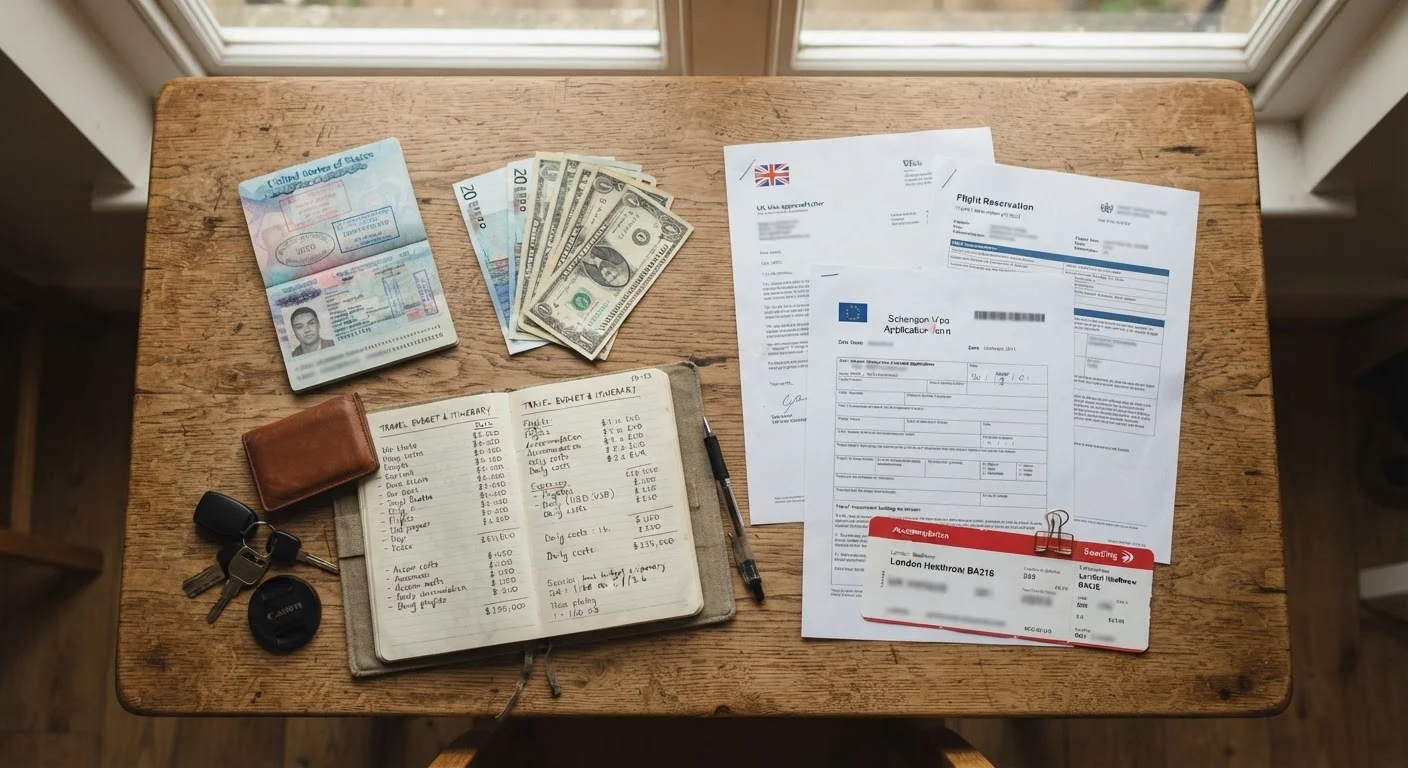


Why Most Travel Budgets Fall Apart
The typical traveler builds a trip budget by estimating a round daily number - say, $80 or $120 - and hoping for the best. That approach fails for a predictable reason: it conflates fixed costs already paid with variable costs still to be incurred, ignores category-level discipline, and provides no mechanism for catching overspend before it compounds into a crisis.
A budget that actually holds requires a different architecture - one built category by category, stress-tested against real destination costs, and adjusted dynamically during the trip. The six steps below provide that structure.
What you will need
Spreadsheet or budgeting app
Records estimated versus actual daily spend across all categories in real time.
Currency converter (offline-capable)
Converts local prices to your home currency instantly, even without a data connection.
Destination cost reference
Provides baseline daily cost ranges for food, transport, and activities at your destination.
Low-fee debit or travel card
Allows ATM withdrawals and purchases without excessive foreign transaction fees eating into your budget.
Following the Six-Step Framework
Work through these steps sequentially before departure, then return to steps 5 and 6 while you travel. Steps 1 through 4 are planning-phase work; steps 5 and 6 are on-the-road disciplines.
Calculate your true discretionary daily allowance
Start by subtracting every pre-paid, fixed cost - flights, pre-booked accommodation, rail passes, travel insurance - from your total trip budget. Divide what remains by the number of travel days. That figure is your discretionary daily allowance: the only number that matters for on-the-ground spending decisions.
For example: a $3,000 trip budget minus $1,200 in fixed costs over 18 days leaves $100 per day in discretionary spend. This step forces you to confront reality before departure rather than mid-trip.
Assign a target to each spending category
Split your discretionary daily allowance across five categories: food, local transport, activities/entrance fees, incidentals (toiletries, SIM cards, laundry), and a contingency buffer. A common starting split for mid-range international travel is: food 35%, local transport 20%, activities 25%, incidentals 10%, contingency 10%.
Adjust proportions to match your destination and travel style. A city-hopping itinerary demands more transport budget; a slow-travel approach in one location may shift weight toward food and activities. See The Building Blocks of a Realistic Daily Travel Budget for a detailed category breakdown.
Research destination-specific cost baselines
Generic budget advice fails because daily costs vary enormously by region. A $60-per-day budget is comfortable in Southeast Asia and strained in Scandinavia. Use recent traveler forums, destination-specific budget guides, and official tourism data to validate your category targets against real local prices.
Cross-reference your estimates against typical cost ranges for food, transport, and activities to confirm your numbers are grounded in current realities rather than outdated assumptions. If your itinerary spans multiple countries, build a separate daily target for each destination segment - costs can shift dramatically at a border crossing.
Build a currency fluctuation buffer into your baseline
Exchange rates move. A rate shift of 8-10% against the US dollar - common over a multi-week trip - effectively raises or lowers every single daily cost. To protect yourself, calculate your daily targets at an exchange rate roughly 8% less favorable than the current mid-market rate. If the math still works, your budget is resilient.
For trips spanning multiple currencies, apply this buffer independently to each currency. See Managing Money Across Borders Without Losing It to Fees for practical guidance on minimizing conversion losses at ATMs and point of sale.
Track spending daily using a rolling three-day average
Log every expense at the end of each day - in local currency, then converted to USD. Rather than measuring strictly against today's target, calculate a rolling three-day average: add the last three days' total spend and divide by three. If that average consistently exceeds your daily target, you have an overspend pattern, not a one-time spike, and need to adjust.
This method absorbs the reality of uneven spending - a museum day costs more than a beach day - without requiring perfect daily discipline. For a complete framework on daily overspend recovery, see Making a Daily Spending Limit Work Across an Entire Trip.
Conduct a mid-trip budget review and recalibrate
At the midpoint of your trip, total your actual spend to date and compare it against what you should have spent by that day. If you're ahead of budget, you can loosen category targets for the second half. If you're behind, identify which categories are overrunning and make concrete cuts - not vague intentions to "spend less."
Recalibrating mid-trip is far more effective than white-knuckling through the back half on an unrealistic original target. For long-term travelers managing this rhythm over weeks or months, Managing Money on a Long-Term International Trip offers deeper guidance on sustaining financial stability over extended travel.
Pre-booking cuts budget uncertainty significantly
Every major cost you lock in before departure - tours, intercity trains, museum entry - removes a variable from your daily discretionary math. The fewer unknowns in your budget, the more accurately your daily targets will hold. Prioritize pre-booking for high-cost or high-variability items first.
Underestimating is the most common budget failure
Most travelers underbudget not because they overspend on big items, but because they fail to account for small, recurring costs: bottled water, transport apps, ATM fees, entry fees for minor sites, and convenience purchases. These categories are explored in detail at Why Travelers Consistently Underestimate Their Daily Spending. Build your incidentals category higher than feels necessary - you will almost certainly need it.
Verify Entry Costs Before Departure
Visa fees, tourist taxes, and mandatory travel insurance requirements are fixed costs that must be factored into your total budget before calculating your daily allowance. These amounts vary by nationality, destination, and entry type. Always verify current requirements directly with the official embassy, consulate, or government immigration authority of your destination before traveling - do not rely on third-party summaries for accuracy.
For travelers navigating itineraries that cross multiple countries or cost tiers in quick succession, the adjustments required go beyond what a single daily target can handle. Daily Budget Best Practices for Complex Multi-Destination Trips covers how to manage those transitions without losing financial control. And if you're looking for destinations where a disciplined daily budget stretches furthest, Budget Destinations is a useful starting point for identifying high-value regions for US travelers.
This article provides general financial planning information for travel purposes and does not constitute personalized financial advice. Prices, exchange rates, and entry requirements change frequently - verify all figures with official and current sources before making travel decisions.