

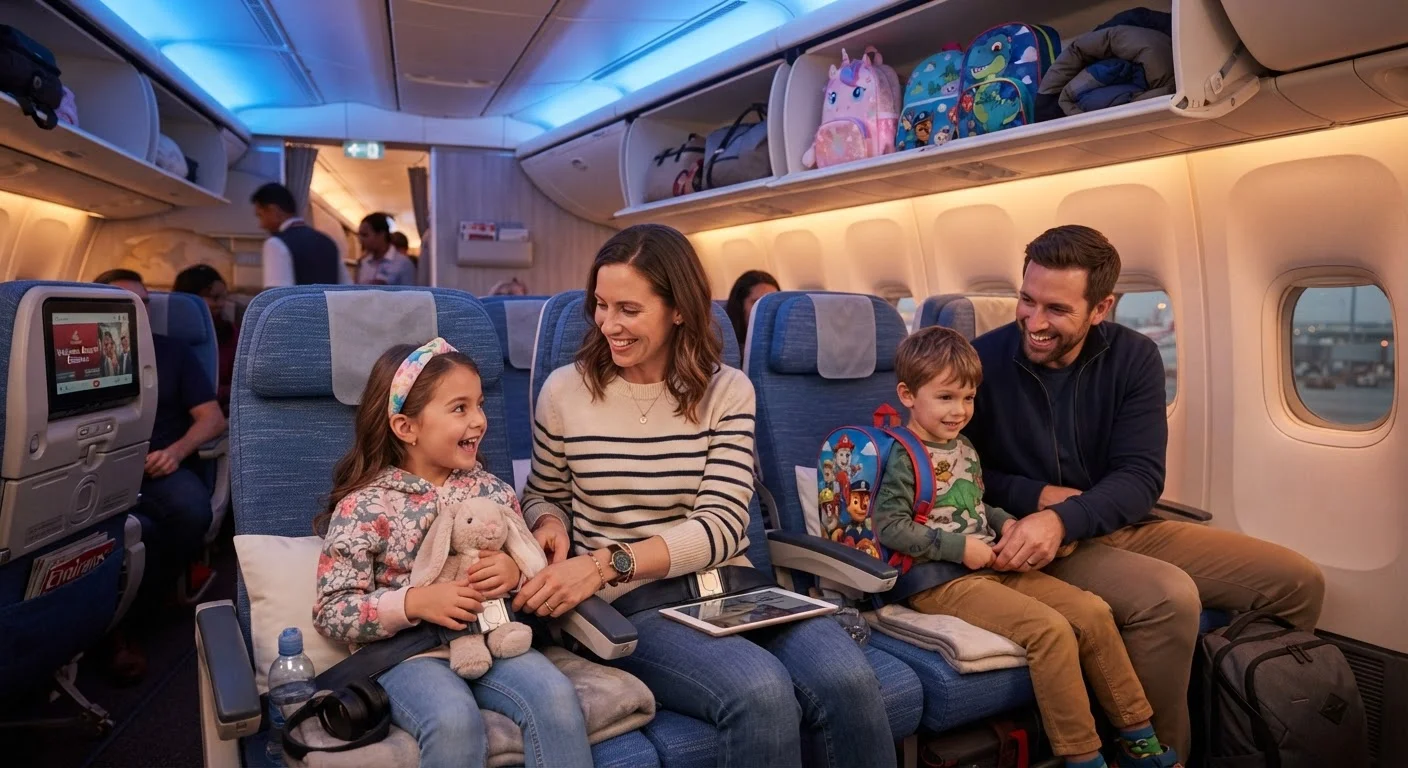
Start With the Documents
Before a single flight is booked, your family's paperwork needs to be airtight. Passport issues and missing documentation are the leading reason families get turned away at check-in or immigration - and they're entirely preventable with early action.
Every child, regardless of age, needs their own valid passport for international travel. Processing times vary and can stretch considerably during busy periods, so apply or renew at least six months before your intended departure. Many countries also require that your passport remain valid for 3-6 months beyond your return date - check your destination's specific rules.
If one parent is traveling solo with the children, or if a child shares a different surname, a notarized parental consent letter is strongly recommended and required for entry into certain countries. Our guide to passports and parental consent walks through exactly what to prepare.
Lap infant
A child under 2 years old who travels seated on an adult's lap rather than in their own ticketed seat. Most airlines offer a reduced fare or free domestic travel for lap infants, though international flights typically require a small percentage of an adult fare.
Bassinet row
A row of seats, usually at a bulkhead (the wall between cabin sections), where airlines can attach a small fold-down crib for infants. These rows offer more floor space and must usually be requested directly through the airline.
Circadian rhythm
Your body's internal 24-hour clock that regulates sleep and wakefulness. Crossing multiple time zones disrupts this rhythm, causing jet lag - a temporary mismatch between your body clock and the local time at your destination.
Parental consent letter
A notarized document signed by an absent parent or guardian giving permission for a child to travel internationally. Some countries require this at the border; even where not mandatory, it can prevent delays if a child's travel party is questioned.
Bulkhead seat
A seat positioned directly behind a cabin dividing wall. These seats offer extra legroom and no seat in front to recline into your space - popular with families but limited in number on any aircraft.
Always verify visa, entry, and documentation requirements with the official embassy or consulate of your destination country before booking - requirements can change and vary by nationality.
Choosing Your Flight Wisely
Not all long-haul routes are created equal when you're traveling with little ones. A few strategic choices at booking time can dramatically change your in-flight experience.
- Overnight departures work well for toddlers and early elementary kids who can sleep through much of the flight naturally.
- Direct vs. connecting: A longer nonstop flight is almost always preferable to two shorter legs with a connection. Layovers with young children are exhausting - and tight connections become genuinely risky. If a connection is unavoidable, build in generous time. Our breakdown of layover length explains exactly how much buffer you need.
- Bulkhead and bassinet rows are gold for families with infants. These must typically be reserved directly with the airline - don't rely on seat selection tools to surface them.
- Seat configuration: Study the aircraft map before choosing seats. Families of four traveling in a 2-4-2 or 3-3-3 layout can sit together without straddling an aisle.
Consider how this trip fits into a bigger itinerary - a single long-haul fare can often anchor a multi-destination adventure. Our piece on multi-city itineraries for families shows how to maximize one big flight.
Book Seats Together Early
Many airlines release family seat blocks that get claimed quickly, especially bulkhead and bassinet rows. Call the airline directly after booking - seat selection tools on booking sites don't always surface all available family configurations. Confirming your seats early is one of the highest-value steps you can take for a smoother flight.
Managing Time Zones and Sleep
Jet lag in young children can hit harder than in adults - partly because kids' sleep schedules are more rigid, and partly because an overtired child on a crowded airplane is nobody's favorite scenario. The good news: you can soften the blow significantly with a little advance preparation.
Before departure: Begin shifting bedtime by 15-30 minutes per night in the direction of your destination, starting 4-5 days out. This micro-adjustment approach is far gentler than trying to flip schedules overnight.
On the plane: Align mealtimes and sleep attempts with the destination's local schedule rather than your home time zone. Use window shades, travel pillows, and familiar comfort items to signal sleep.
On arrival: Morning sunlight is one of the most effective natural tools for resetting circadian rhythms. Get outside early, keep daytime naps short (under an hour), and aim for a regular local bedtime on night one, even if that means a tired, grumpy dinner. Things typically normalize within 2-4 days for most young children.
Curious whether kids really struggle as much as you fear? Our article on how kids handle long trips may give you some welcome reassurance.
In-Flight Logistics for Young Kids
The cabin is your temporary home for 8-14 hours - treat it that way. A few practical habits make the difference between a tolerable flight and a genuinely pleasant one.
Watch for Cabin Pressure and Ear Pain
Young children - especially infants - can experience significant ear discomfort during takeoff and descent due to rapid cabin pressure changes. Encourage swallowing by nursing, offering a bottle, or giving older children gum or a snack during these phases. If your child has a current ear infection, consult your pediatrician before flying.
Movement matters: Build in regular aisle walks, especially every 2-3 hours. Young children can't stay seated comfortably for long stretches, and movement helps prevent the restlessness that escalates into meltdowns. Many families rotate one parent walking the aisles while the other rests.
Screen time strategy: Load tablets with a mix of familiar favorites and a few new downloads as a novelty reward - save the new content for the hardest stretch of the flight. Bring child-sized headphones; airline sets rarely fit small ears well.
Food: Airline meal timing rarely aligns with a toddler's hunger, so pack reliable snacks from home. If your child has dietary restrictions or allergies, our guide to traveling with dietary restrictions has practical strategies for communicating needs in advance.
Families with children spanning a wide age range face a particular challenge balancing different needs simultaneously - our piece on traveling with mixed-age kids addresses exactly that dynamic.
What to Pack in Your Carry-On
Your checked bags could go anywhere. Your carry-on is your lifeline. Pack it as if it's the only luggage you'll have for the first 24 hours - because occasionally, it is.
Essential carry-on categories for families with young children:
- Comfort and sleep: A small stuffed animal or comfort item, travel blanket, and inflatable footrest for toddlers who can't reach the floor.
- Clothing: A full change of clothes for each child, plus one set for at least one adult. Spills and accidents happen at 35,000 feet.
- Medications: Any prescription medication in its original packaging, plus children's pain reliever and motion sickness remedies if your child is prone. Verify what you can carry through security before travel.
- Entertainment: Pre-loaded tablet, headphones, a few small activity books or sticker sets, and one or two new small toys revealed mid-flight.
- Snacks: Familiar, reliable, low-mess options. Avoid anything that smells strongly or crumbles everywhere.
For a full structured checklist covering every age group, see our family travel packing list. And if this long-haul trip is part of a bigger family travel strategy, the complete guide to travelling with children of different ages is your broader roadmap.
Stroller Check-In at the Gate
Most airlines allow you to check a stroller at the gate, meaning you can use it all the way through the airport and retrieve it immediately at your destination's gate - not at baggage claim. Confirm your airline's specific gate-check policy when you book, as handling procedures vary by carrier and airport.