

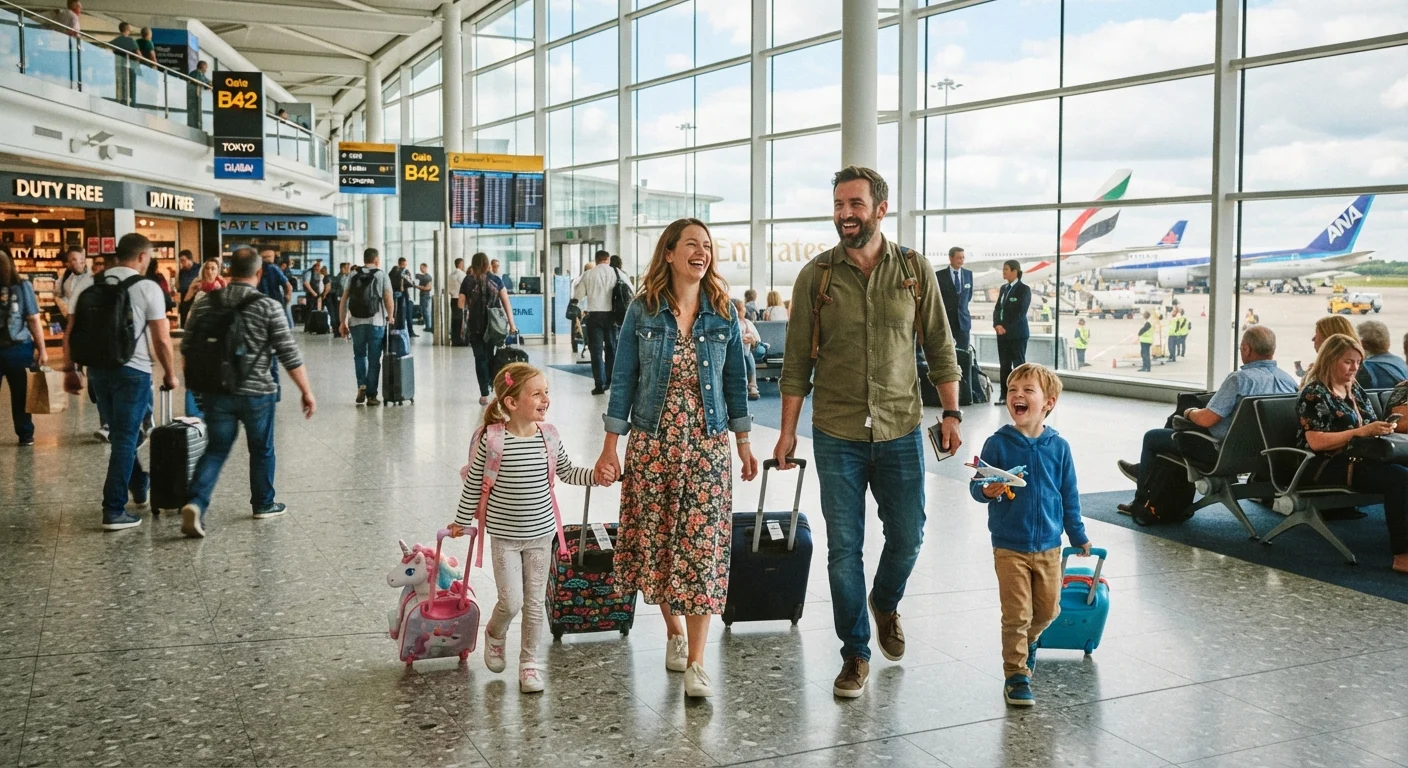
The Gap Between Fear and Reality
Before almost every family trip, a familiar anxiety sets in: What if the kids can't handle it? Long flights, strange beds, unfamiliar food, disrupted routines - the list of potential meltdown triggers can feel endless. But experienced traveling families will tell you something that the worry rarely accounts for: children are genuinely more adaptable than their parents give them credit for.
That gap between anticipated disaster and actual experience is largely built on myths - assumptions that get passed around in parenting circles and amplified by social media's appetite for catastrophe. The families you don't hear from are the ones who had a perfectly fine, occasionally brilliant trip. Below, we unpack the most persistent misconceptions so you can stop bracing for impact and start actually planning.
Myth
Long flights with kids are guaranteed disasters that will ruin the trip before it starts.
Fact
Most families report that long flights go far more smoothly than feared when basic preparation is in place.
The horror stories that circulate about flying with children tend to be memorable precisely because they're exceptions. In practice, children - especially those under five - often sleep through substantial portions of long-haul flights, particularly on overnight routes. Familiar snacks, a downloaded playlist of their favorite shows, and a small bag of new (inexpensive) activities can carry most kids through hours of airtime without a crisis. For a deeper look at the logistics, see our guide to long-haul international travel with young children.
Myth
Kids get so jet-lagged on international trips that the first few days are a total write-off.
Fact
Children often adjust to new time zones faster than adults, especially younger ones whose sleep patterns are already flexible.
While jet lag is real for children, pediatric sleep researchers note that younger kids tend to recalibrate more quickly than adults, partly because their circadian rhythms are less rigidly set. Keeping kids well-hydrated, getting them into natural daylight at the destination, and gently nudging mealtimes toward the new schedule helps considerably. Symptoms vary significantly by age - our article on jet lag in children breaks down what to expect at different developmental stages.
Myth
Children need constant entertainment on the road or they'll melt down.
Fact
Kids are often remarkably good at finding interest in new environments - the novelty itself is the entertainment.
A train window, a busy market, a new playground, or even the mechanics of a hotel elevator can fascinate a child for far longer than a parent expects. The instinct to pack an arsenal of devices and toys is understandable, but it can actually backfire - overstimulation or a dead battery can become a crisis point. A more balanced approach, including some device time without guilt, tends to work better than either extreme. Our piece on screen time on holiday offers a thoughtful framework for setting expectations before you leave.
Myth
Kids will refuse unfamiliar food and you'll spend the whole trip hunting for chicken nuggets.
Fact
Travel often expands children's palates - new contexts make children more willing to try unfamiliar food.
Food neophobia (fear of new foods) is a well-documented phase, but travel can actually work in parents' favor. The excitement of a new place, eating alongside locals, and seeing food prepared differently can reduce resistance in ways that dinner at home never achieves. That said, packing a few familiar snacks as a safety net is always sensible. Families managing genuine dietary restrictions will find specific strategies in our guide to travelling with children who have dietary restrictions.
Myth
A packed, structured itinerary is the only way to keep kids from getting bored or cranky.
Fact
Over-scheduled trips often exhaust children (and parents) faster - unstructured time is a feature, not a failure.
Families who try to see everything frequently report more conflict and fatigue than those who build in slow mornings, lingering lunches, and genuinely free afternoons. Children are not miniature tourists ticking off landmarks; they process experiences differently and need downtime to absorb what they've seen. A simpler itinerary that leaves room for spontaneous discovery usually produces happier memories for everyone. See our family trip planning hub for approaches that match pace to your kids' ages and temperaments.
What Actually Determines How Kids Cope
Reading through these myths, a clear pattern emerges: the variables that most influence how children handle long trips are largely within a family's control. Preparation, pacing, and parental attitude matter far more than the child's age, the destination's distance, or the length of the journey.
72%
Parents who worried more than necessary
A survey by the Family Travel Association found that roughly 72% of parents said their trips went better than they expected when traveling with children under 10.
3-4 days
Typical child jet-lag adjustment window
Pediatric sleep specialists generally cite a 3-4 day adjustment period for children crossing multiple time zones, often shorter than the adult equivalent.
Children are acutely sensitive to adult stress. When parents board a flight braced for catastrophe, kids absorb that tension - and sometimes fulfill the expectation. Approaching travel with calm confidence, even if it's partly performed, has a measurable effect on how children respond to challenges along the way.
For families navigating multiple children at different developmental stages, the dynamics get more complex but not unmanageable. Our complete guide to travelling with children of different ages covers the specific considerations each age group brings. And if your crew spans toddlers to teens, traveling with mixed-age kids offers planning strategies to keep everyone genuinely on board.
Preparation Isn't the Same as Over-Planning
There's an important difference between sensible preparation - packing familiar snacks, downloading entertainment, knowing your hotel's check-in time - and building an itinerary so rigid that any deviation triggers a family crisis. Over-planning can create its own kind of stress. Leave buffer time in every day, and resist the urge to schedule every hour. Kids need space to be kids, even on vacation.
The single most consistent finding from families who travel regularly with kids? They wish they'd started sooner and worried less. The trip you almost didn't take is almost always worth it.