

Start Before You Board: Seat Selection and Flight Timing
The groundwork for a smoother flight happens days before you ever reach the airport. Two decisions matter most: when you fly and where you sit.
Early morning departures tend to align with toddler schedules better than midday or late-afternoon flights. Kids are typically well-rested, airports are less chaotic, and if the flight coincides with naptime, there's a real chance they'll doze off mid-route. Avoid back-to-back red-eyes unless you're prepared for a very awake toddler at 2 a.m.
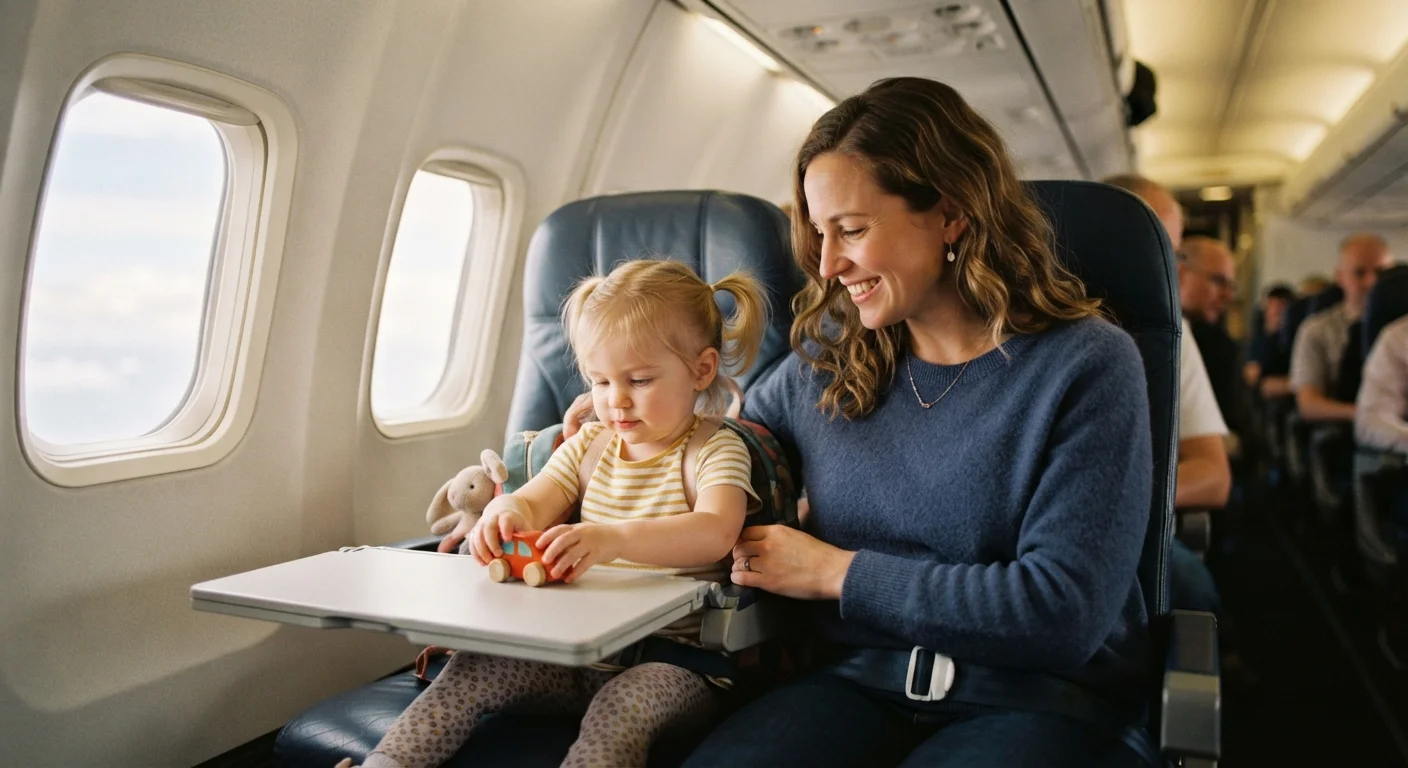
For seat selection, a bulkhead row offers extra floor space - useful for a toddler who needs to stretch. Window seats give kids a distraction and prevent them from lunging into the aisle. If you're traveling with a partner, book an aisle and a window in the same row; on most narrow-body aircraft, the middle seat between you is likely to stay empty on less-full flights, and if someone does book it, they'll almost certainly swap.
Also worth knowing: children under two can fly as lap infants on domestic U.S. flights, but the FAA recommends that all small children use an approved car seat secured to their own seat. Check official FAA guidelines and your airline's policies before booking. See our long-haul flight planning guide for additional detail on documents and seat logistics for international trips.
The Airport Itself: Moving Through Without Melting Down
Airports are stimulating, overwhelming, and full of waiting - a perfect storm for toddler dysregulation. A little strategy goes a long way.
Most U.S. airports allow families with young children to use dedicated security lanes - ask at the checkpoint. TSA PreCheck can be worthwhile for families who fly more than twice a year; children under 12 can accompany an enrolled adult through PreCheck lanes without paying for their own enrollment.
Once through security, resist the urge to let your toddler burn energy by running freely if your gate area is small. Instead, find a quieter corner or a carpeted children's play area (many major airports now have them) and let them roam there. Save the full-energy sprint for after you land.
Board strategically. Many airlines offer early family boarding - use it to get settled, stow your bag, and arrange your toddler's space before the rush. But if your child is likely to hit their patience ceiling fast, consider letting one adult board early while the other keeps the toddler moving in the terminal until the last possible moment.
In the Air: Snacks, Surprises, and the Art of the Distraction
Once the seatbelt sign clicks off, your real toolkit comes out. Here's what experienced family travelers consistently rely on:
Pack a dedicated toddler carry-on stocked with tiered snack reveals
Hunger accelerates toddler meltdowns faster than almost anything else at altitude. Spacing out snacks as timed reveals - rather than offering everything at once - extends their entertainment value significantly and gives you a tool to deploy when things get tense.
Bring two to three wrapped novelty items to unwrap mid-flight
New objects capture toddler attention in ways familiar toys cannot. The act of unwrapping itself is engaging, and novelty buys far more focused time than a toy they've seen a hundred times.
Time screen time for the hardest stretch - not the takeoff
Many parents deploy their toddler's tablet immediately at boarding, burning through the most powerful distraction tool before the flight even reaches cruising altitude. Saving it for the middle hour - when novelty has worn off and landing feels far away - pays off.
Practice pressure equalization with snacks or sippy cups during descent
Ear pain during descent is one of the most common causes of toddler distress on flights and is easily overlooked by first-time flying parents. Swallowing repeatedly helps equalize pressure in small ears.
Keep a change of clothes for your toddler - and yourself - in your personal item
Spills, motion sickness, and diaper blowouts don't care about flight time. Being caught without a change of clothes can turn a manageable incident into a miserable hour.
One underrated move: bring a small, soft backpack your toddler can treat as their bag. Fill it with sticker books, a mini figurine, and a couple of their favorite snacks. Kids this age respond remarkably well to ownership - having their own bag to open and manage gives them a sense of control that reduces fussiness.
For screen time, download content in advance. Streaming doesn't always work at altitude, and airplane Wi-Fi is unreliable. A downloaded episode of a favorite show can buy 20-30 minutes of quiet. Noise-canceling toddler headphones (volume-limited ones are widely available) help block cabin noise and keep the audio from bothering neighboring passengers.
The 'Reset Walk' Really Works
When your toddler hits a wall and nothing seems to help, a slow walk to the back galley and back - even just once - can break the cycle. The change of environment, movement, and novelty of seeing the galley area often resets mood faster than any toy or snack. Flight attendants are generally very understanding of families doing this, especially if you're polite and pick a calm moment between service.
If a meltdown happens - and it might - take a breath. A short walk to the galley, a change of scenery, or simply a calm parent voice is often enough to reset. Most passengers are far more understanding than anxious parents expect. For more perspective on this, see why kids handle long trips better than you think.
Building Confidence for the Trips Ahead
Flying with a toddler is genuinely hard the first time - and genuinely easier by the third. Each trip teaches you more about your child's patterns, what works in the air, and how to pack smarter.
Every Toddler Flight Gets Easier
Parents often assume that one rough flight means flying with their child is 'not for them.' In reality, most seasoned family travelers report that each successive trip with a toddler goes more smoothly as both parent and child build familiarity with the routine. The strategies that feel clunky and improvised the first time become second nature by the third trip. Give yourself - and your child - that learning curve.
If your family includes older children alongside a toddler, the dynamic adds another layer of coordination. Our guide on traveling with mixed-age kids covers how to balance competing needs without turning every flight into a negotiation. And if you're weighing whether to fly at all, road trip vs. flight with kids offers a grounded comparison for different family situations.
The families who travel most confidently with toddlers aren't the ones with the most gear - they're the ones with realistic expectations and a few well-practiced moves. That's entirely learnable. You've got this.
Under 2
Age at which children fly free as lap infants on most U.S. domestic routes
FAA guidelines recommend a separate seat with an approved car seat for safety, even when lap infant fares are available - verify current rules with your airline before booking.
15-25 min
Focused attention span a novel wrapped toy can capture in a toddler
Child development research consistently shows that novelty and the act of unwrapping are independently engaging for children ages 1-3, independent of the toy's complexity.