
Why Standard Search Habits Leave Money on the Table
Most travelers search the same way every time: origin to destination, specific dates, round trip. That approach works, but it skips entire categories of fare structures that airlines price differently - sometimes dramatically so. The tactics below require a bit more planning, but they operate on real pricing logic, not luck.
These strategies complement the fundamentals covered in our complete guide to finding cheap flights. Think of them as the next layer - approaches worth adding once you've already got flexible dates and fare alerts in your toolkit. For a thorough look at how fare alerts fit into the bigger picture, see our guide on setting a fare alert that actually pays off.
Open-Jaw Tickets: Fly In One City, Out of Another
An open-jaw ticket is a fare structure where your outbound and return flights use different airports. For example, you fly from New York to Rome, travel overland through Italy, and fly home from Milan. Airlines price these as a single itinerary, and the total is often lower than buying two separate one-way tickets - sometimes comparable to a standard round trip.
The practical benefit beyond cost: you eliminate backtracking. Open-jaw routing is especially efficient when exploring a region linearly - say, a road trip from Lisbon to Madrid, or a train route through Japan. Search for open-jaw fares by using the multi-city booking tool on most major booking platforms and entering different departure and return airports.
Open-jaw fares eliminate backtracking and often cost less than two separate one-way tickets.
Positioning Flights: Use a Hub to Access Better Long-Haul Deals
If your home airport is a smaller regional hub, long-haul international fares from there can be significantly higher than from a major gateway city like New York (JFK), Los Angeles (LAX), or Chicago (ORD). A positioning flight - a short, inexpensive domestic hop to a gateway - can open access to transatlantic or transpacific fares that more than compensate for the extra leg.
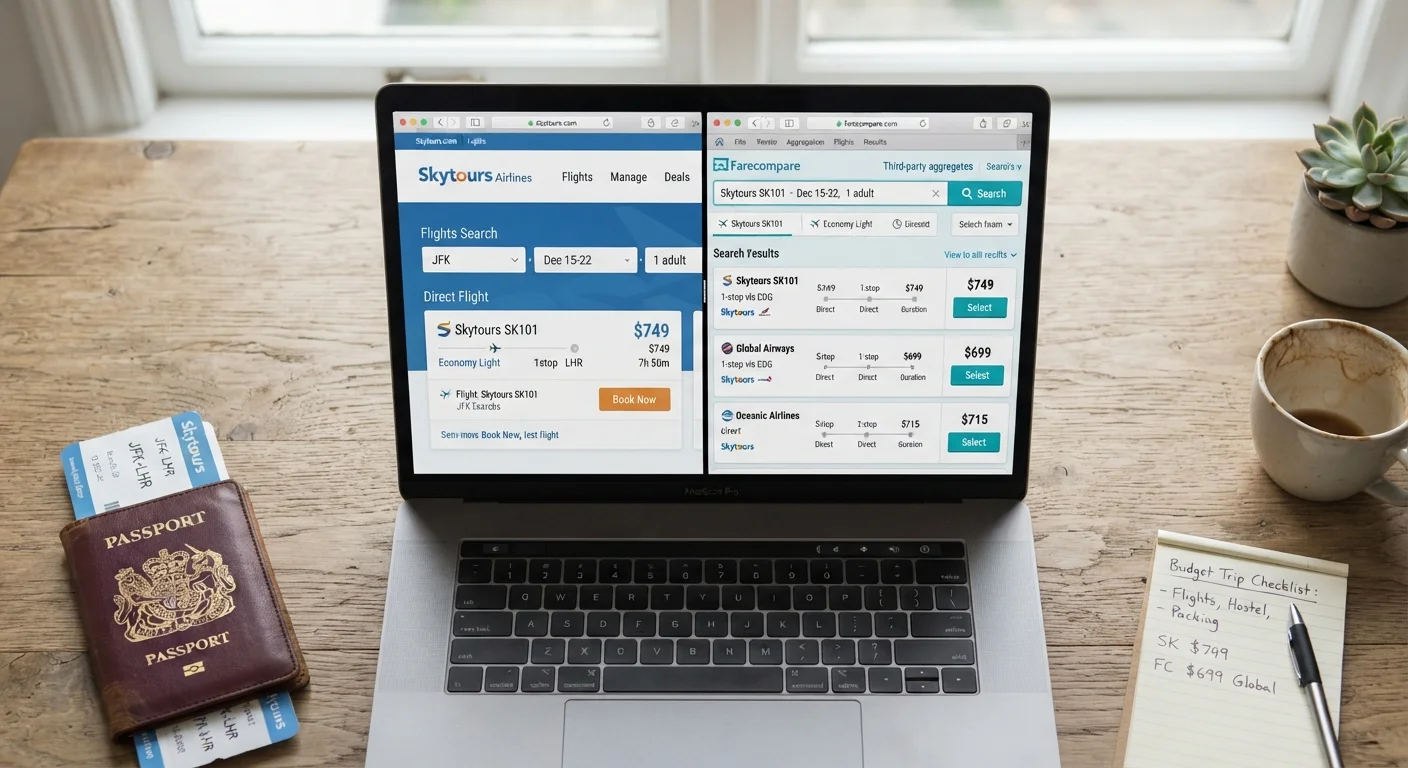
Run the math carefully: add the cost of the positioning flight, any overnight stay if needed, and ground transport. Compare the total against booking directly from your home airport. On routes to Europe or Asia, the savings window can be wide enough to make the extra travel worthwhile. Flexible date searching helps identify which departure windows at the hub airport are cheapest.
A cheap domestic hop to a major gateway can unlock international fares unavailable from smaller home airports.
Nearby Airport Swaps: When the Drive Is Worth It
Flying into or out of an alternate airport serving the same metro area can produce meaningful fare differences. The New York metro area has three major airports; Los Angeles has two with a third regional option nearby; the San Francisco Bay Area has three. Fare discrepancies between these airports on the same route and date can reach $100 or more.
The calculation requires honesty about ground costs. Factor in parking, car rental, rideshare, or transit from the alternate airport to your actual destination. If the alternate airport is 90 minutes further but the fare is $80 less, the net benefit may be minimal after time and transport costs. For more unconventional approaches to airport selection, our article on nearby airports and unconventional fare tactics covers the trade-offs in detail.
Always net the alternate airport fare against real ground transportation costs before declaring it a win.
Hidden-City Ticketing: Understand the Risks Before Trying It
Hidden-city ticketing exploits a pricing quirk: a flight from City A to City C with a layover in City B is sometimes cheaper than a direct flight from A to B. If City B is your actual destination, you book the A-C itinerary and simply disembark at B, skipping the onward segment.
This is legal for the traveler but explicitly prohibited by most airline contracts of carriage. The consequences are real: checked baggage will travel to City C, not City B. Airlines can cancel return segments on the same booking. Frequent flyer accounts have been closed for repeated use. It is only viable with carry-on luggage and one-way bookings. Treat it as a last-resort option, not a routine strategy, and research the current policy of the specific airline involved. This tactic carries financial and logistical risk and should be approached with full awareness of those downsides.
Hidden-city ticketing is explicitly banned by most airline contracts and carries real consequences if detected.
Multi-City Routing Through Hub Logic
Airlines price tickets based on origin-destination pairs and the competitive landscape of each route. A flight from a mid-size US city to a secondary European city may be expensive because it involves a single carrier on both legs. Rerouting through a competitive hub - booking two separate tickets that use different carriers or alliances - can reduce total cost, though it introduces risk if the first flight is delayed.
The key constraint: when you book two separate tickets, no airline is responsible for your connection if you miss it due to a delay on the first flight. Build in a generous connection buffer - at minimum three to four hours for international connections - and consider whether the savings justify the exposure. Our practical booking walkthrough covers how to evaluate these trade-offs at the search stage.
Separate-ticket hub routing can save money but eliminates airline rebooking protection if you miss a connection.
Red-Eye and Off-Peak Departure Timing
Overnight and early-morning departures are frequently priced lower than peak daytime slots on the same route. Airlines fill these less desirable time slots with fare incentives. On domestic routes, early-morning departures also tend to have better on-time performance because aircraft haven't accumulated delays through the day.
The trade-off is fatigue and disrupted sleep, which carries real costs on the other end - especially if you need to be functional immediately on arrival. Our article on red-eye flight trade-offs covers the full picture. The savings are real; so is the physical toll. Factor both into the decision, particularly on trips where the first day matters.
Red-eye fares are genuinely lower, but the fatigue cost is real and worth planning around.
Putting It All Together
None of these tactics work in isolation every time - their value depends on your route, flexibility, and risk tolerance. The key is knowing they exist and running the numbers before defaulting to a standard round-trip search. Even one of these approaches applied to a single itinerary can offset a significant portion of your total trip budget.
Run the Full-Cost Comparison
When evaluating any unconventional routing - positioning flights, nearby airports, separate-ticket connections - build a simple total-cost comparison that includes ground transport, any overnight stays, and the value of your time. A fare that looks $120 cheaper can evaporate quickly once transfer costs are included. The tactic only wins if the net saving is meaningful after all expenses are counted.
For travelers planning trips with multiple stops, our guide on structuring a multi-destination trip to keep airfare under control goes deeper on combining open-jaw, hub routing, and regional carriers into a coherent, cost-efficient itinerary.
Prices, policies, and airline rules change frequently. Always verify current fare structures, baggage fees, and ticketing terms directly with the airline or a licensed travel agent before booking. This article is for general informational purposes and does not constitute personalised financial or travel advice.