

Why Fuel Habits Matter More on Long Trips
On a typical commute, a few MPG here or there barely registers. But stretch that into 2,000 miles of open highway and the math changes fast. Fuel is routinely one of the top three road trip budget items - and unlike lodging or food, it's almost entirely within your control. See how it fits into the bigger spending picture in our guide to where road trippers overspend on fuel, food, and lodging.
The key insight: fuel efficiency on a road trip is less about your vehicle's EPA rating and more about how you actually drive it. Highway conditions, load, speed discipline, and even your route elevation profile all interact. The habits below address each of those levers in practical terms.
~15%
Fuel economy loss from driving 80 mph vs. 60 mph
According to US Department of Energy data, most vehicles see significant MPG drops above 60 mph due to aerodynamic drag.
1-2%
MPG reduction per 100 lbs. of extra cargo
The US Department of Energy estimates that every 100 pounds of added weight reduces fuel economy by roughly 1-2% in the average passenger vehicle.
~0.5%
Fuel economy loss per 1 PSI of underinflation
US Department of Energy guidance suggests underinflated tires can reduce fuel economy by approximately 0.5% for each PSI below the recommended level.
Speed Is the Biggest Variable You Control
Aerodynamic drag increases exponentially with speed. The US Department of Energy notes that fuel economy typically decreases significantly above 50 mph - for many vehicles, every 5 mph over 60 is roughly equivalent to paying meaningfully more per gallon. On a multi-day trip, the time saved by cruising at 80 mph instead of 65 is often less than 30-45 minutes per day, while the fuel cost difference can be substantial.
The practical takeaway: set cruise control at or just below the speed limit on interstates. Modern cruise control also smooths out subtle speed fluctuations that waste fuel during long flat stretches.
Set cruise control on interstates and target speeds between 60-65 mph.
Aerodynamic drag rises sharply with speed, making higher speeds disproportionately expensive. Cruise control eliminates the micro-speed fluctuations that add up over hundreds of highway miles.
Check and correct tire pressure the morning you depart, before the tires warm up.
Underinflated tires increase rolling resistance across every mile you drive. The cumulative drag effect on a multi-day trip is significant and completely avoidable.
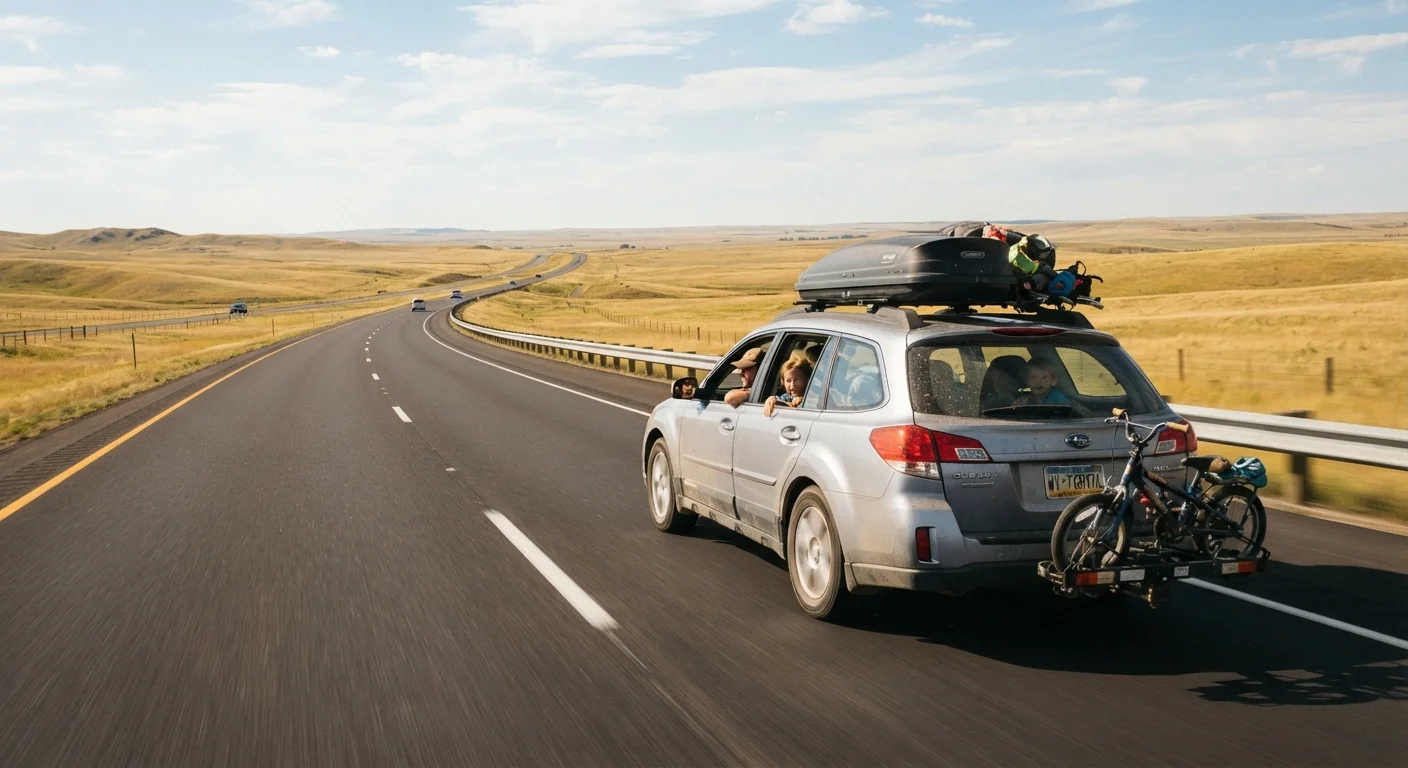
Remove rooftop cargo carriers when they aren't needed and pack the vehicle interior instead.
Rooftop carriers add both dead weight and pronounced aerodynamic drag at highway speeds. The drag penalty from a roof box is often greater than the weight penalty from equivalent cargo loaded inside.
Anticipate stops and coast to decelerate rather than braking late.
Every hard braking event wastes kinetic energy that took fuel to generate. Looking further ahead and modulating throttle early converts that energy into a smooth rollout instead of heat.
Plan your route to avoid sustained elevation gain where alternatives are comparable in distance.
Climbing significant grades burns fuel at a rate that flat-highway figures don't reflect. On routes with route options, a flatter corridor may deliver better real-world MPG even if the mileage is similar.
Use the AC's recirculation mode once the cabin is cool, and switch to outside air only when needed.
Recirculating already-cooled cabin air reduces how hard the AC compressor has to work, lowering the engine load and improving fuel economy during sustained highway driving.
Pre-Trip Prep: The Fuel Savings You Lock In Before You Leave
Several of the most impactful efficiency gains happen in your driveway, not on the road. Tire pressure is the most commonly neglected factor - underinflated tires create rolling resistance that quietly drains your tank across every mile. Check your vehicle's door-jamb sticker (not the tire sidewall) for the correct PSI and inflate accordingly the morning you depart, when tires are cold.
Cargo weight matters more than most road trippers realize. An extra 100 pounds in the trunk reduces fuel economy by roughly 1-2% for the average passenger vehicle, according to the US Department of Energy. That roof cargo carrier is even worse - it adds both weight and significant aerodynamic drag. Pack selectively, and load rooftop gear only if there's truly no interior option.
Also consider your departure timing. Stop-and-go traffic burns fuel at a dramatically higher rate than steady highway cruising. Leaving early enough to clear metro congestion - especially when departing from a major city - can meaningfully cut your first tank's consumption.
Driving Technique: Smoothness Pays Dividends
Aggressive acceleration followed by heavy braking is essentially converting fuel into heat with no useful motion as the payoff. Anticipating traffic flow - looking further ahead than you normally would in city driving - lets you modulate speed with subtle throttle adjustments rather than constant brake-and-accelerate cycles.
On long downhill grades, lift off the throttle early and let gravity do the work rather than maintaining speed with the accelerator. On uphill grades, allow some speed loss rather than flooring it to maintain cruise control's set point - the engine has to work dramatically harder to sustain speed on an incline. This matters on routes through the Rockies, Appalachians, or the Sierra Nevada, where elevation changes are sustained and steep.
Use the 'Lift Early, Brake Late' Rule on Hills
When you see a significant downhill ahead, lift off the throttle early and let gravity accelerate the vehicle rather than maintaining cruise control speed. On the uphill side, allow a modest speed drop rather than forcing the engine to sustain set speed - this is when fuel consumption spikes most sharply. Turning off cruise control on mountainous sections and managing speed manually often saves more fuel than drivers expect.
If you're weighing whether a road trip or flying makes more financial sense for your family overall, comparing the true costs of road trips versus flying lays out the full picture. And for a quick take on shorter getaways, drive or fly for a weekend trip covers the trade-offs cleanly.
Air Conditioning, Windows, and the Eternal Debate
At highway speeds, running the AC is generally more fuel-efficient than opening windows - open windows at 65+ mph create enough drag to offset the compressor load. Below about 45 mph, the opposite is often true. Practically, this means: use AC on the highway, crack windows in slow city traffic or when idling in a campground parking lot.
Recirculation mode on your AC system also matters. When recirculating cabin air instead of pulling in hot outside air, your AC compressor works less to hit the set temperature. Switch to recirculation once the interior is cooled down.
Parking in shade during midday stops keeps the cabin cooler so you need less AC time when you restart - a small gain that adds up on a hot summer road trip through the Southwest. For more strategies on keeping your daily travel costs manageable, including transport and fuel across multi-day trips, check out our broader budget hub.
Fuel economy figures referenced here are drawn from publicly available US Department of Energy guidance. Real-world results vary by vehicle type, load, driving conditions, and individual habits. Always verify current fuel prices and conditions before departure.