
Why Security Myths Persist - and What They Actually Cost You
Airport security is one of the most stress-dense parts of any trip, and stress breeds bad logic. Travelers swap tips at gates, repeat strategies that felt like they worked once, and inherit folklore from friends who flew a decade ago. The result is a set of persistent beliefs that don't hold up - and that cost real time when acted on.
This isn't a matter of obscure edge cases. The myths below affect decisions travelers make every single trip: which lane to pick, what to pack, how to dress, when to arrive. Getting these wrong doesn't just slow you down at the checkpoint - it can raise your stress level before you've even boarded. If broader booking misconceptions also affect your planning, see how similar pattern-thinking distorts decisions in flight booking timing myths.
Myth
Switching to a shorter security lane will get you through faster.
Fact
Lane length is a poor predictor of wait time. Throughput depends on staff levels, traveler preparedness, and equipment status - none of which are visible from the back of the queue.
A lane with five people ahead of you can grind to a halt if one traveler triggers a manual bag check or an imaging machine goes offline. The lane you abandon may clear in 90 seconds. TSA publishes average wait times for major airports through its app, which is a more reliable signal than visual queue length. If your airport offers it, check that data instead of lane-hopping.
Myth
CLEAR replaces TSA PreCheck, so you only need one.
Fact
CLEAR and TSA PreCheck serve completely different functions and neither substitutes for the other.
CLEAR is an identity-verification service that uses biometrics to confirm who you are, moving you to the front of the document-check line. TSA PreCheck is a risk-based screening program that changes how you are screened - shoes stay on, laptops stay in the bag, belts stay on. You can have CLEAR without PreCheck and still undergo standard screening; you can have PreCheck without CLEAR and still wait in the standard ID line. Many frequent travelers use both, but they address different friction points entirely.
Myth
The 3-1-1 liquids rule means you can't bring any large liquids in checked luggage either.
Fact
The 3-1-1 rule applies exclusively to carry-on bags. Checked baggage generally allows larger liquid containers, subject to airline and hazardous-materials limits.
The 3-1-1 rule - containers of 3.4 oz (100 ml) or less, in one quart-sized clear bag, one bag per passenger - was designed for the carry-on X-ray screening process. Checked bags go through different screening and are not subject to the same size restriction for most liquids. Exceptions exist for flammable or pressurized items regardless of bag type. Confirm specific item rules at tsa.gov before packing anything you're uncertain about.
Myth
You must remove all electronics from your bag at security.
Fact
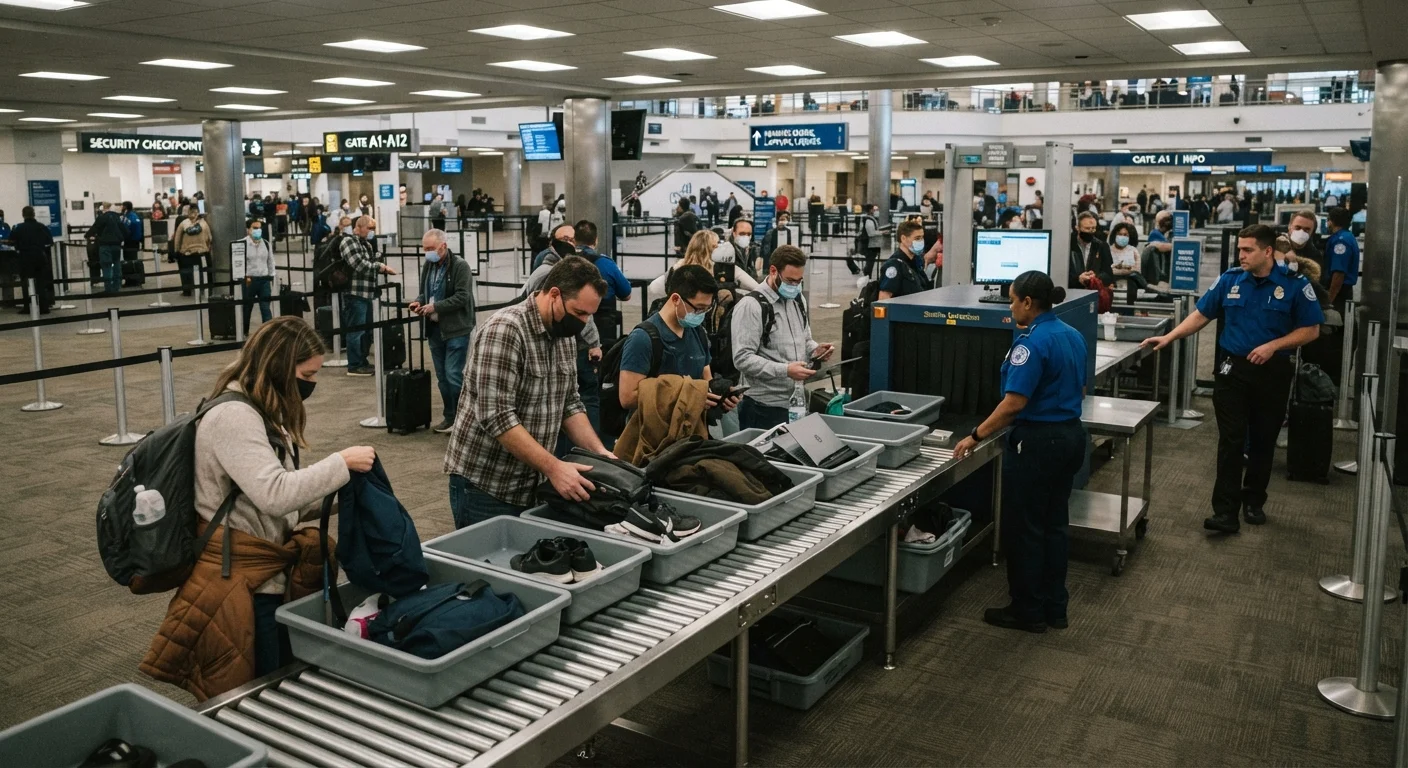
Under standard TSA screening, only laptops need to be removed from bags and placed in a separate bin. Other personal electronics stay in your carry-on.
The laptop-removal requirement exists because the density of a laptop can obscure other items in X-ray imaging. Tablets, e-readers, phones, and cameras do not carry the same requirement under current standard rules. TSA PreCheck members are not required to remove laptops at all. Some individual airport checkpoints may post additional instructions - follow signage and officer direction if it differs from the general rule.
Myth
Wearing minimal clothing speeds up security significantly.
Fact
Modern imaging technology means clothing itself is rarely the cause of delays. What you carry - not what you wear - is the main driver of screening time.
Metal-detecting body scanners and millimeter-wave imaging have largely replaced older walk-through metal detectors at major U.S. airports. These systems flag anomalies under or on clothing regardless. The real time cost comes from packed bags with dense or ambiguous contents, forgotten liquids, and loose items in pockets. Efficient packing and a cleared-out carry-on consistently do more for throughput than dressing lightly.
Myth
Arriving three or more hours early guarantees you won't miss your flight due to security.
Fact
Arrival time reduces risk but cannot eliminate it. Security wait times are unpredictable, and extremely early arrival can create its own complications.
At most domestic U.S. airports, TSA recommends arriving two hours before departure. Three or more hours is standard guidance for international departures. Arriving significantly earlier than that doesn't guarantee a shorter security line - it just means waiting longer airside. For travelers connecting to tight itineraries, the more useful variable is how much buffer your layover provides, not raw arrival time at the origin airport.
What Actually Moves You Through Security Faster
Once the myths are out of the way, the practical picture is fairly consistent: preparedness beats strategy. Pack your carry-on so a screener can read it clearly on X-ray - dense, jumbled bags get pulled for manual inspection far more than light ones. Keep your liquids bag at the top. Empty your pockets before you reach the bin area, not while you're holding up the line.
Don't Rely on Fellow Travelers for Security Rules
Well-meaning advice from other passengers is one of the most common sources of security misinformation. What worked at a different airport, in a different year, or under a different traveler's trusted status may not apply to your situation. When in doubt, check tsa.gov or ask a TSA officer directly before reaching the checkpoint.
If you travel frequently, enrolling in TSA PreCheck is one of the highest-return investments a budget traveler can make - not because it's a perk, but because it eliminates the most time-consuming parts of standard screening. It does not, however, guarantee PreCheck lane access on every flight; that depends on airline participation and the specific airport checkpoint. Check your boarding pass for the PreCheck indicator before assuming you'll use that lane.
Verify Rules Before Every Trip
TSA screening procedures can change without broad public announcement. Always check the official TSA website (tsa.gov) before travel, especially after a long gap between flights. Rules around specific items - including medical devices, food, and powders - are updated periodically and vary by airport security tier.
For travelers navigating complex itineraries with connecting flights, security efficiency at the origin airport is only part of the equation. The layover buffer you build into your itinerary matters just as much - sometimes more - than how fast you clear the first checkpoint.
~93M
TSA PreCheck-eligible travelers screened annually
TSA reports screening tens of millions of PreCheck passengers per year, with PreCheck lanes typically moving faster than standard lanes at participating airports.
3.4 oz
Maximum carry-on liquid container size allowed
The TSA 3-1-1 rule, in effect since 2006, limits individual liquid containers in carry-on bags to 3.4 fluid ounces (100 ml) per item.